A new gas range or dryer usually arrives with a delivery crew who will set it in place and leave it unplugged from the gas. Many delivery services do not connect gas at all, and the ones that do will not touch a valve that is old, a line that is capped in the wrong spot, or an appliance set up for the wrong fuel. That is the gap a hookup fills.
Connecting an appliance looks simple: a valve, a flexible connector, two fittings. The details are what make it safe. The valve has to be in the right place and accessible. The connector has to be listed, the right size and length, and not pinched behind the appliance. The appliance has to be set up for the fuel you actually have. And the finished connection has to be leak-checked with gas on and the burners lit and checked.
We hook up gas appliances in homes and businesses on natural gas and on propane across Spartanburg County and Gaffney, and we check the existing line can carry the new load before we connect it.
As a Piedmont Natural Gas Advantage Partner, we can also help when the appliance is the reason you want gas in the first place: a new Piedmont service to a house that has never had it, or a switch from propane to natural gas. Financing through Piedmont is available on qualifying gas work, on Piedmont's terms.
- Piedmont Natural Gas Advantage Partner
Call for a hookup when
- A new gas range, cooktop, wall oven or dryer is being delivered
- You are replacing a gas water heater, tank or tankless
- The appliance was bought for natural gas and your home runs on propane, or the other way around
- The old shutoff valve is stiff, leaking or hidden behind a cabinet
- The existing connector is old brass, kinked, or runs through a wall or cabinet
- You are moving a gas appliance to a new spot in the kitchen or laundry room
- You want gas to an outdoor kitchen, a fire pit, a gas lantern or a pool heater
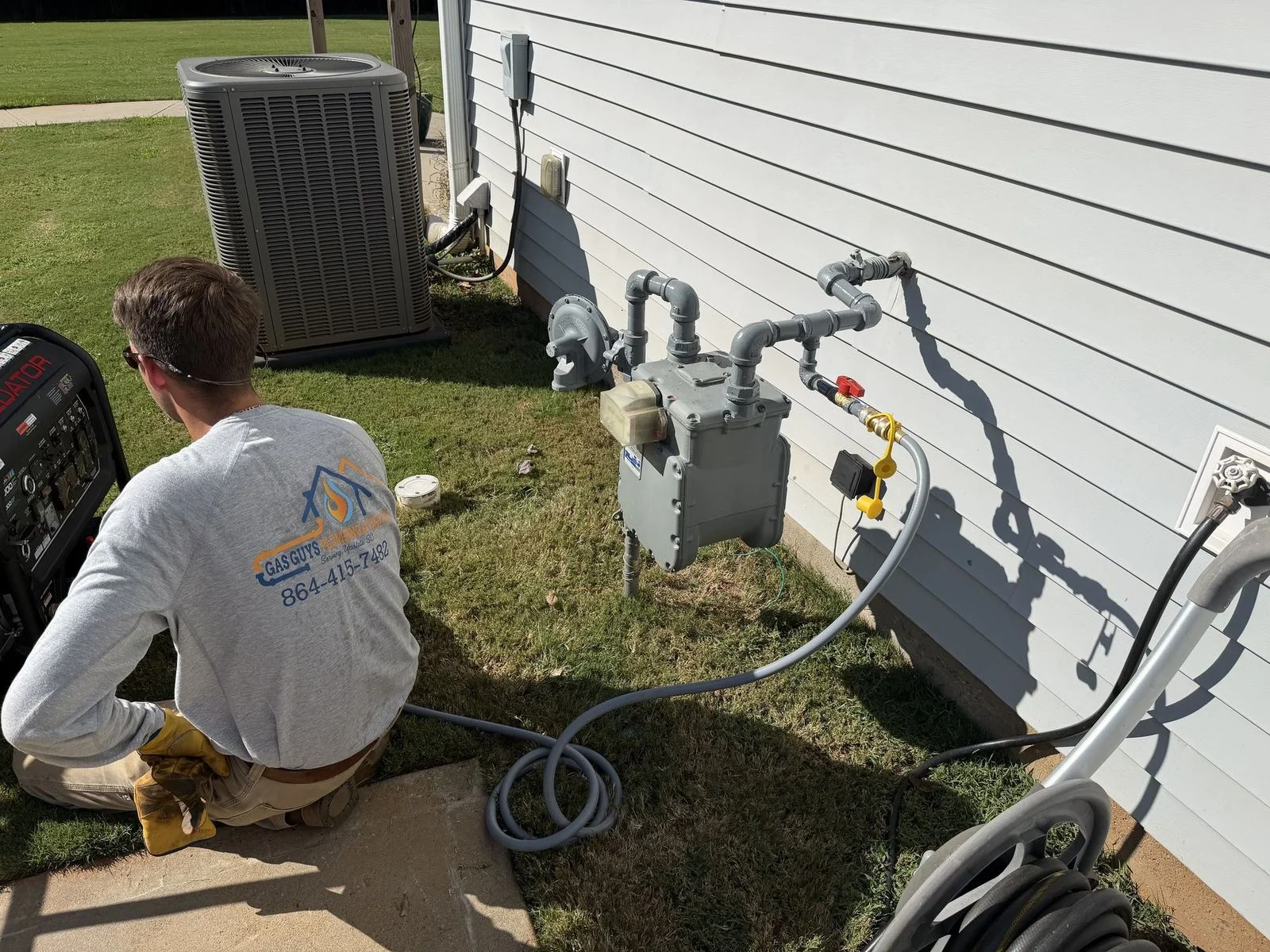
- You are adding a standby generator, or a quick-connect for a portable generator built to run on natural gas
Appliances we connect
- Gas ranges, freestanding and slide-in
- Cooktops and wall ovens
- Gas clothes dryers
- Tank water heaters
- Tankless water heaters
- Gas furnaces and space heaters
- Gas logs and fireplace inserts
- Grills, outdoor kitchens, fire pits and fire tables
- Gas lanterns
- Pool and spa heaters
- Standby generators
- Quick-connects for natural gas portable generators
What a correct hookup includes
Every gas appliance gets its own manual shutoff valve. The fuel gas code puts it in the same room as the appliance, within 6 feet of it, and where you can reach it without moving the appliance or tearing anything out. Behind a range that usually means a valve low on the wall or in the base cabinet next to it, so the range can be shut off without pulling it out.
Downstream of the valve is the connector. It must be listed for gas appliance connections, sized for the appliance's BTU rating, no longer than the listing allows, and installed without kinks or sharp bends. It cannot pass through a wall, floor or cabinet or be hidden in the appliance housing. On a range that slides in and out, there has to be enough slack that the connector flexes rather than stretching.
Finally, every new connection is checked with a leak solution and an electronic detector with the gas on, then each burner is lit and the flame checked. A good flame on natural gas is crisp and blue; lazy yellow flame or soot means something is off with the setup or the fuel.
Sediment traps: where they go and where they do not
A sediment trap, also called a drip leg, is a short capped pipe nipple below a tee at the appliance inlet. Gas changes direction at the tee, and any scale, dirt or moisture in the line drops into the capped leg instead of into the appliance's gas valve.
The code requires a sediment trap at the inlet of most gas appliances, including water heaters and furnaces, as close to the inlet as practical. It makes exceptions for a few appliances, among them ranges, clothes dryers, outdoor grills and decorative vented appliances like gas logs. Manufacturers can still call for one, and their instructions control, so we check the book that came with the unit.
A water heater without a sediment trap is a common home-inspection finding. When we replace or reconnect a water heater, it gets one.
Natural gas or propane: conversion kits
Natural gas and propane burn differently and are delivered at different pressures, so the orifices that meter gas into each burner and the regulator inside the appliance are set for one fuel. An appliance set for natural gas running on propane gets far too much fuel; one set for propane running on natural gas gets far too little.
Many ranges and dryers can be converted with a manufacturer's kit, and many ranges ship with the propane parts in the box. Conversion means swapping or adjusting the burner orifices, changing or flipping the regulator, adjusting the oven and broil burners and the low simmer settings, and labeling the appliance for the fuel it now burns. It is a job for a qualified technician, and the kit instructions are specific to the model.
Water heaters are different. Many gas water heaters cannot be field-converted at all and must be bought for the correct fuel. Check the rating plate before it is delivered. In much of rural Cherokee County and the edges of Spartanburg County, homes run on propane, so this mix-up is common.
Will your line carry the new appliance
A swap of a range for a range or a dryer for a dryer rarely changes the load. Adding an appliance does. A gas range where there was electric, a tankless water heater in place of a tank, or a second appliance teed into an existing branch can push the line past what it was sized to deliver.
When that happens, nothing leaks. The new appliance or the ones already on the line simply do not get enough gas when several run at once: a tankless unit that throws an error mid-shower, a furnace that short-cycles on a cold morning, a range burner that will not hold a full flame. We check the BTU load against the pipe size and length before connecting. If the line is too small, we say so and quote the line work separately.
How a gas appliance hookup runs
-
Confirm fuel and fit
We check the appliance rating plate against your fuel, natural gas or propane, and look at the valve, the connector route and the space.
-
Check the load
For a new or larger appliance we add up the BTUs on the line and confirm the pipe can deliver them.
-
Convert if needed
If the appliance needs the manufacturer's conversion kit, we install it and label the appliance for its fuel.
-
Valve, trap and connector
A new or verified shutoff valve within reach, a sediment trap where required, and a new listed connector of the right size and length.
-
Leak check under gas
Every joint we made is checked with leak solution and an electronic detector with the gas on.
-
Light and adjust
Each burner is lit and the flame checked. On water heaters we check the venting draft, and on dryers the exhaust run.
Not sure this is the problem? Describe what is happening and we will tell you.
(864) 415-7482Permits for appliance hookups
Water heater replacements and new gas appliance installations are generally permitted work in Spartanburg County, through the City of Spartanburg inside city limits or the county building codes office outside them. Cherokee County, and cities with their own building departments, permit within their own jurisdictions.
Rules for a like-for-like range or dryer reconnect vary by jurisdiction. When a permit is required we pull it. When new piping is involved, the piping is pressure-tested and inspected before the appliance is connected.
What affects the cost of an appliance hookup
Every job is priced before work starts. These are the things that move the number.
- Is the valve already there
- A good valve in the right spot means a straight connection. A missing, leaking or buried valve has to be replaced or moved first.
- Conversion
- Converting an appliance between natural gas and propane adds time and the manufacturer's kit, which is model-specific.
- New piping
- Moving an appliance or adding a gas appliance where there was electric means extending the line, then testing it.
- Line capacity
- If the existing line cannot carry the new load, part of it may need upsizing toward the meter.
- Venting and exhaust
- Water heaters need correct venting and dryers need a sound exhaust run. Problems found there are fixed before the appliance runs.
- Permit
- Where the work requires a permit, the fee is set by the city or county.
Who supplies gas in your town
Your utility owns the main and the meter and handles gas emergencies at the meter. Everything after the meter is yours, and that is the piping we install and repair.
| Town | Natural gas | Permits |
|---|---|---|
| Spartanburg | Piedmont Natural Gas | City of Spartanburg Building Inspections; Spartanburg County Building Codes outside city limits |
| Boiling Springs | Piedmont Natural Gas | Spartanburg County Building Codes |
| Inman | Piedmont Natural Gas | City of Inman (processed by SAFEbuilt) |
| Chesnee | Piedmont Natural Gas or propane | Cherokee County Building Safety, after City of Chesnee zoning approval |
| Cowpens | Piedmont Natural Gas | Town of Cowpens (building safety by CC&I Services) |
| Gaffney | Piedmont Natural Gas | City of Gaffney Community Development; Cherokee County Building Safety outside city limits |
| Duncan | Greer CPW | Town of Duncan |
| Wellford | Greer CPW | City of Wellford |
| Lyman | Greer CPW | Town of Lyman zoning approval, then CC&I Services |
| Moore | Varies: Piedmont, Greer CPW or propane | Spartanburg County Building Codes |
| Woodruff | Piedmont Natural Gas | City of Woodruff Building Department |
| Landrum | Greer CPW | City of Landrum (start at City Hall); Spartanburg County Building Codes outside city limits |
| Campobello | Mostly propane (no gas main confirmed) | Spartanburg County Building Codes (confirm with Campobello Town Hall) |
| Roebuck | Piedmont Natural Gas | Spartanburg County Building Codes |
| Pacolet | City of Union (Union Gas) | Town of Pacolet, through its contracted building inspection firm |
| Converse | Piedmont Natural Gas | Spartanburg County Building Codes |
| Fairforest | Piedmont Natural Gas | Spartanburg County Building Codes |
| Startex | Greer CPW or Piedmont (check your bill) | Spartanburg County Building Codes |
| Reidville | Greer CPW | Town of Reidville (zoning approval, then CC&I for permits); Spartanburg County outside town limits |
| Arcadia | Piedmont Natural Gas | Spartanburg County Building Codes |
| Clifton | Piedmont Natural Gas | Spartanburg County Building Codes |
| Drayton | Piedmont Natural Gas | Spartanburg County Building Codes |
| Fingerville | Propane in most homes; check for Piedmont service | Spartanburg County Building Codes |
| Glendale | Piedmont Natural Gas (where mains reach) | Spartanburg County Building Codes |
| Gramling | Varies: propane or natural gas, by road | Spartanburg County Building Codes |
| Greer | Greer CPW | City of Greer Building and Development Standards (inside city limits) |
| Holly Springs | Varies: Greer CPW, Piedmont or propane | Spartanburg County Building Codes |
| Mayo | Varies: Piedmont where mains run, propane elsewhere | Spartanburg County Building Codes |
| Pacolet Mills | City of Union (Union Gas); confirm on your bill | Town of Pacolet, through its contracted building inspection firm |
| Pauline | Varies: Piedmont where mains run, propane elsewhere | Spartanburg County Building Codes |
| Southern Shops | Piedmont Natural Gas | Spartanburg County Building Codes |
| Una | Piedmont Natural Gas | Spartanburg County Building Codes |
| Whitestone | Varies: Piedmont where mains run, propane elsewhere | Spartanburg County Building Codes |
| Chimney Rock | Propane (no gas main) | Rutherford County Building Inspections (village zoning permit first) |
| Lake Lure | Propane (no gas main) | Rutherford County Building Inspections (Town of Lake Lure zoning permit first) |
| Forest City | Enbridge Gas North Carolina | Town of Forest City Building Inspections |
| Rutherfordton | Enbridge Gas North Carolina | Rutherford County Building Inspections (town zoning permit first for additions) |
| Spindale | Enbridge Gas North Carolina | Rutherford County Building Inspections (town zoning permit first for additions) |
| Union Mills | Mostly propane | Rutherford County Building Inspections |
| Mill Spring | Enbridge Gas North Carolina (limited); propane elsewhere | Polk County Building Inspections |
| Tryon | Enbridge Gas North Carolina | Polk County Building Inspections (Town of Tryon zoning permit first) |
| Columbus | Enbridge Gas North Carolina | Polk County Building Inspections (Town of Columbus zoning permit first) |
| Green Creek | Mostly propane | Polk County Building Inspections |
Utility territories have edges, and rural homes past the mains run on propane. Check your bill if you are unsure.
Why call Gas Guys for a hookup
We check the whole connection
Valve, trap, connector, fuel setup and flame, not just the two fittings the delivery crew would have tightened.
Natural gas and propane
We work on both, and we catch the wrong-fuel appliance before it is lit, not after.
We tell you about the line
If the new appliance will starve the old ones, you hear it before we connect it.
We explain the work
You will know where your shutoff is and how to use it before we leave.
A Piedmont Advantage Partner
New Piedmont service, propane-to-natural-gas switches and Piedmont financing on qualifying work, handled with the hookup.