The sewer line that runs from your house to the city sewer, sometimes called the lateral, carries everything that goes down every drain. When it fails, the whole house feels it: slow drains everywhere, backups in the lowest tub or floor drain, and sometimes a sewer smell or a soggy spot in the yard.
Cleaning the line clears a clog. When the pipe itself is broken, sagging or full of roots, the line needs a repair, and that usually means digging.
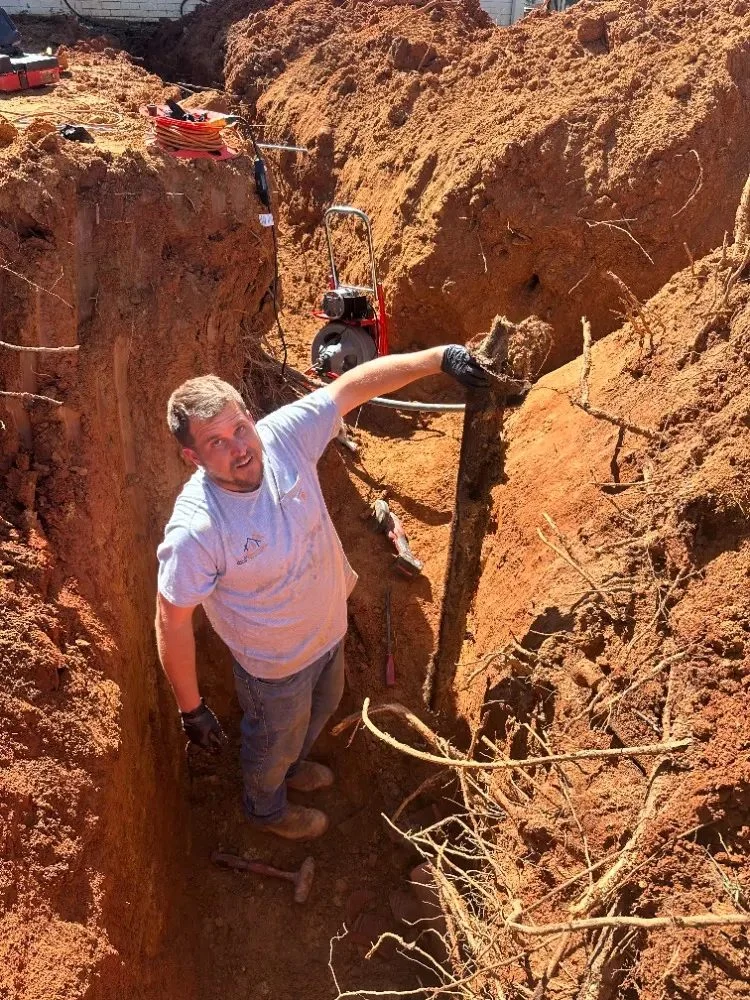
Sewer and yard pipe digs are work we do ourselves, and customers mention them in our reviews. We find the problem, show you what we found, and repair or replace the line. We also install new sewer lines, from a house coming off septic onto public sewer to a line for a new building or an addition.
Signs of a sewer line problem
- Several drains are slow or back up at the same time
- The main line has needed cleaning more than once in a year
- Sewage comes up in the lowest tub, shower or floor drain
- A sewer smell in the yard or near the foundation
- A soggy, sunken or unusually green strip in the yard along the sewer route
- Roots on the cable after a drain cleaning
Roots, bellies and collapsed pipe
Most sewer line failures we see come down to a few causes, and a camera inspection usually tells us which one it is.
- Roots: tree roots grow into the joints of older pipe looking for water, then fill the line.
- Bellies: a section of pipe that has sunk and holds water and waste instead of draining. Solids settle there, and the line clogs again and again at the same spot.
- Breaks and offsets: a cracked pipe or a joint that has shifted out of line.
- Collapse: pipe that has failed completely, so the line is blocked by soil. Nothing cleans through it, and it has to be dug up and replaced.
Clay and Orangeburg pipe in older homes
Homes from the mid-twentieth century and earlier often have clay tile sewer pipe. It comes in short lengths, and every joint is a place for roots to get in.
Some homes from roughly the 1940s through the early 1970s have Orangeburg pipe, made of wood fiber and tar pitch. It softens and deforms over the decades, going oval and then collapsing. If your house is from that era and the sewer keeps clogging, Orangeburg is one of the first things we look for. Neither clay nor Orangeburg is worth patching for long. Replacement with PVC is the lasting repair.
Who owns the sewer line
The sewer provider owns the main in the street. Spartanburg Water, which runs the Spartanburg Sanitary Sewer District, states that residents are responsible for the service lines on their property that connect to its system, and other area sewer providers such as the Gaffney Board of Public Works work in a similar way. The exact point where your responsibility ends, whether at the property line, a cleanout or the main, is set by each provider, so check with yours if the problem is near the street.
If a backup is caused by a blockage in the sewer main itself, that is the utility's problem. Spartanburg Water says that a backup can come from your private plumbing or from its main in the street.
Installing a new sewer line
New sewer lines come up in a few ways: a public sewer main reaches a street of septic homes, a detached building or an addition needs its own drain line, or an old line is past repair and is replaced end to end. Each one starts with the sewer provider, which sets where and how a new connection can be made to its system.
Grade is what makes a sewer work. The plumbing code sets a minimum slope, 1/8 inch per foot for a typical 4-inch building sewer, and we give it more where the ground allows. Too flat and solids settle; we lay the pipe on firm bedding so it holds that grade for decades instead of sagging into a belly.
We install PVC sewer pipe with a cleanout near the house and more along long runs, so the line can be cleaned and camera-inspected later. The new line is tested and inspected before the trench is closed. When a septic home connects to sewer, the old tank has to be abandoned to the state's rules, and that part is for a septic contractor.
Sewer or septic
Not every home in Spartanburg and Cherokee counties is on a public sewer. Many homes outside the cities and sewer districts are on septic systems, which are permitted through the South Carolina Department of Environmental Services.
On a septic home, the line from the house to the tank is the same kind of pipe and fails the same ways. Pumping the tank and drain field work is a job for a septic contractor. If your drains are slow and you are on septic, a tank that is due for pumping is the first thing to rule out.
How a sewer line repair goes
-
Clear the line and look
We clear the backup through the cleanout, then inspect the line with a camera to find the problem and where it is.
-
Locate and mark
We locate the depth and route of the problem section and call SC811 to have utility lines marked before digging.
-
Dig it up
We excavate at the problem, keeping the dig as small as the repair allows.
-
Repair or replace
A broken section is cut out and replaced with PVC. A failed clay or Orangeburg line is replaced, usually with a cleanout added near the house.
-
Test, inspect and backfill
We run water to confirm flow and have the work inspected where a permit applies, then backfill and tamp the trench.
Not sure this is the problem? Describe what is happening and we will tell you.
(864) 415-7482Permits for sewer work
Replacing a building sewer is generally permitted work, inspected by the city or county building department, and some sewer providers have their own rules for connecting to their system. We pull the permit where one is required and coordinate with your sewer provider if the work reaches their connection.
What drives the cost of sewer repair
Every job is priced before work starts. These are the things that move the number.
- Spot repair or full replacement
- One broken joint is a smaller dig than a full line from the house to the street.
- Depth
- Deeper lines mean more digging and, past a certain depth, more care with the trench walls.
- What is on top
- Driveways, patios, trees and landscaping over the line add work.
- Soil and rock
- Wet red clay and rock both slow a dig.
- Permit and inspection
- Fees are set by the city or county.
Why homeowners call Gas Guys for sewer lines
We dig our own jobs
Reviews mention our sewer and yard pipe digs. We do not hand the hard part off.
We show you the problem
Before you approve a dig, you see what we found and where.
Honest about repair vs replace
A single bad joint gets a spot repair. A failed Orangeburg line gets replaced. We tell you which you have.
Answered 24/7
A sewer backup cannot wait. Call any hour.