A standby generator is the hungriest gas appliance most homes will ever have. When the power goes out in an ice storm, it starts, picks up the house, and runs flat out for hours or days, often while the furnace, the water heater and the range are drawing gas at the same time. The gas line has to keep up with all of it.
That is why the gas side of a generator install deserves as much attention as the electrical side. A line that is too small, or a meter that cannot pass enough gas, does not leak or fail a test. The generator simply sags under load, the voltage drops, and it may shut itself down right when you need it.
We size and run the gas supply for natural gas and propane standby generators, connect it at the pad the way the manufacturer specifies, test it, and work alongside the electrician who sets the unit and the transfer switch.
- Piedmont Natural Gas Advantage Partner
Plan the gas side early if
- You are pricing a whole-house standby generator
- Your meter is on the opposite side of the house from where the generator will sit
- You already have a tankless water heater or several large gas appliances
- Your home runs on propane and the tank was sized for heat and hot water only
- An installed generator struggles, surges or shuts down under heavy load
- You are replacing an old generator with a larger one
What a generator gas hookup includes
- Load calculation for the generator plus every other gas appliance
- A line sized for full-load draw over the actual length of the run
- Coordination with the gas utility on meter capacity
- Buried polyethylene with tracer wire, or steel above ground
- A riser and accessible shutoff valve at the pad
- A sediment trap where the manufacturer calls for one
- The manufacturer's flexible connector at the unit
- Pressure test, and a check of inlet pressure under load
Generators draw a lot of gas
Every generator lists its gas consumption at full load in the installation manual, in cubic feet per hour or BTUs per hour, and lists a separate figure for natural gas and for propane. For a whole-house air-cooled unit that full-load number can rival or exceed everything else in the house combined. We size from the manual for your specific model, not from a rule of thumb.
Sizing has to assume the worst case, because that is when a generator runs. On a cold January night with the power out, the generator is at or near full load and the gas furnace, the water heater and maybe the gas logs are all running too. The line from the meter has to carry the total, and the pipe size depends on that total and on the length of the run, under the tables in the fuel gas code.
Generators also have an inlet pressure range they need to see while running, listed in the manual. We check it with a manometer at the unit, at idle and under load, before the job is done. A pressure that looks fine at rest and drops when the engine loads up is a sizing problem.
Meter capacity and the utility
Your meter and regulator are sized by the utility for the load they expected when service was set. Add a large generator and the total can exceed what the meter is rated to pass. That is not something a contractor can change; the meter belongs to the utility.
So early in the planning we add up the connected load and tell you whether the utility needs to review the meter. In much of Spartanburg County that is Piedmont Natural Gas, and around Duncan, Lyman and Wellford it is Greer CPW. The utility's own schedule governs any meter change, which is why we raise it at the start rather than on install day.
On propane, the same question applies to the tank and regulators. A tank sized for a furnace and a water heater may not vaporize enough gas to run a large generator in cold weather, and its run time on a full tank may be shorter than you expect. Your propane supplier sizes and sets the tank and its regulators; we run the line from there.
At the pad: riser, shutoff and flexible connector
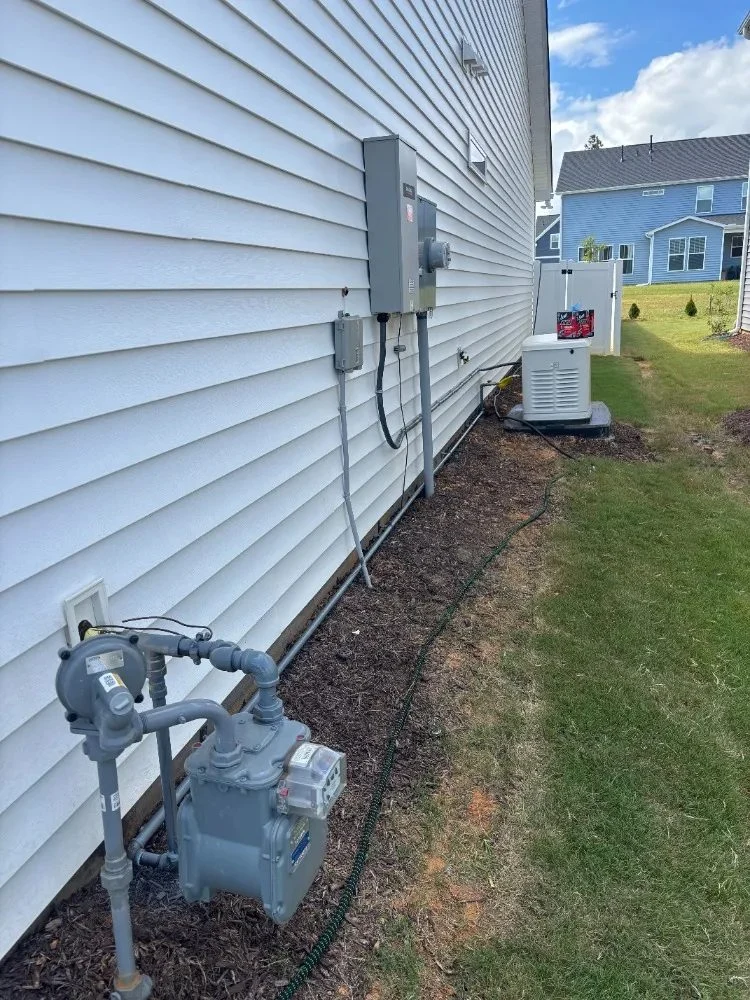
Most generators sit on a pad beside the house, and the gas usually reaches them underground. We run polyethylene pipe below grade with a tracer wire, transition to steel through a riser at the pad, and put a manual shutoff valve there where it can be reached without opening the enclosure.
A generator vibrates when it runs, and a rigid pipe connection would carry that vibration into the riser and threads. Manufacturers specify a flexible connector between the supply piping and the unit's gas inlet, often shipped with the generator, and list where it goes and how it attaches. We follow that, along with any sediment trap the manual calls for at the inlet.
Placement matters too. Manufacturers list clearances from windows, doors, vents and the house wall to keep exhaust out of the home. The generator's location is usually settled with the electrician and the homeowner before the gas line is planned.
Working with the electrician
A generator install is two trades. The electrician handles the pad, the unit, the transfer switch and the wiring to your panel, under the electrical permit. We handle the gas: sizing, piping, testing and connecting the fuel supply. The work goes smoothest when both are planned together.
We set the riser where the electrician will set the unit, schedule the gas test and inspection so the line is ready when the generator is, and are there when it is first started to confirm the gas pressure under load. If you are hiring the electrician yourself, give them our number and we will coordinate directly.
Portable generators and natural gas quick-connects
Some portable generators are built to run on natural gas as well as gasoline or propane. For those, we can run a gas line to an outdoor spot well away from doors, windows and vents, and end it in a shutoff valve and a listed quick-connect coupling, so the generator can be hooked up during an outage without anyone touching the house piping.
The same sizing rules apply on a smaller scale: the line has to carry the generator's rated gas draw along with the furnace and water heater. The generator itself still needs a transfer switch or an inlet installed by an electrician, and it must always run outdoors.
How a generator gas hookup runs
-
Read the manual and add up the house
We take the model's full-load gas consumption and inlet pressure from the installation manual and add every other gas appliance in the home.
-
Check the meter or tank
We compare the total to the meter's capacity, or the propane tank and regulator setup, and bring in the utility or supplier if it needs review.
-
Plan with the electrician
Agree on the pad location, clearances and schedule so the riser lands where the unit will sit.
-
Permit and route
We pull the gas permit and plan the route from the meter, including any underground run and the tie-in point.
-
Install and test
Trench, pipe, tracer wire, riser and shutoff, then a pressure test to the fuel gas code minimum with no drop allowed, and inspection.
-
Connect and verify under load
We install the flexible connector and any sediment trap, purge, and check inlet pressure with the generator running under load.
Not sure this is the problem? Describe what is happening and we will tell you.
(864) 415-7482Permits for a generator gas line
The gas piping to a standby generator is permitted work, and the electrical side carries its own permit. Inside the City of Spartanburg the city issues both; in unincorporated Spartanburg County it is the county's building codes office. Cherokee County, and cities that permit within their own limits, have their own offices.
The gas line is pressure-tested and inspected before it is connected to the generator. If the utility upgrades the meter, it may want the inspected status of the new piping on record first.
What drives the cost of a generator gas line
Every job is priced before work starts. These are the things that move the number.
- Generator size
- A larger unit draws more gas and often needs a larger pipe, sometimes from the meter all the way to the pad.
- Distance from meter to pad
- A pad near the meter is a short run. A pad on the far side of the house means a longer trench or a longer run through the crawlspace.
- Existing load
- Homes with a tankless water heater or several gas appliances leave less room on the existing piping for a generator.
- Meter or tank changes
- If the utility has to upgrade the meter, or the propane tank and regulators need changes, that adds coordination and time.
- Ground conditions
- Upstate red clay, rock, roots, driveways and walks in the path all affect trenching.
- Permit and inspection
- Fees are set by the city or county, and timing follows the inspector's schedule.
Who supplies gas in your town
Your utility owns the main and the meter and handles gas emergencies at the meter. Everything after the meter is yours, and that is the piping we install and repair.
| Town | Natural gas | Permits |
|---|---|---|
| Spartanburg | Piedmont Natural Gas | City of Spartanburg Building Inspections; Spartanburg County Building Codes outside city limits |
| Boiling Springs | Piedmont Natural Gas | Spartanburg County Building Codes |
| Inman | Piedmont Natural Gas | City of Inman (processed by SAFEbuilt) |
| Chesnee | Piedmont Natural Gas or propane | Cherokee County Building Safety, after City of Chesnee zoning approval |
| Cowpens | Piedmont Natural Gas | Town of Cowpens (building safety by CC&I Services) |
| Gaffney | Piedmont Natural Gas | City of Gaffney Community Development; Cherokee County Building Safety outside city limits |
| Duncan | Greer CPW | Town of Duncan |
| Wellford | Greer CPW | City of Wellford |
| Lyman | Greer CPW | Town of Lyman zoning approval, then CC&I Services |
| Moore | Varies: Piedmont, Greer CPW or propane | Spartanburg County Building Codes |
| Woodruff | Piedmont Natural Gas | City of Woodruff Building Department |
| Landrum | Greer CPW | City of Landrum (start at City Hall); Spartanburg County Building Codes outside city limits |
| Campobello | Mostly propane (no gas main confirmed) | Spartanburg County Building Codes (confirm with Campobello Town Hall) |
| Roebuck | Piedmont Natural Gas | Spartanburg County Building Codes |
| Pacolet | City of Union (Union Gas) | Town of Pacolet, through its contracted building inspection firm |
| Converse | Piedmont Natural Gas | Spartanburg County Building Codes |
| Fairforest | Piedmont Natural Gas | Spartanburg County Building Codes |
| Startex | Greer CPW or Piedmont (check your bill) | Spartanburg County Building Codes |
| Reidville | Greer CPW | Town of Reidville (zoning approval, then CC&I for permits); Spartanburg County outside town limits |
| Arcadia | Piedmont Natural Gas | Spartanburg County Building Codes |
| Clifton | Piedmont Natural Gas | Spartanburg County Building Codes |
| Drayton | Piedmont Natural Gas | Spartanburg County Building Codes |
| Fingerville | Propane in most homes; check for Piedmont service | Spartanburg County Building Codes |
| Glendale | Piedmont Natural Gas (where mains reach) | Spartanburg County Building Codes |
| Gramling | Varies: propane or natural gas, by road | Spartanburg County Building Codes |
| Greer | Greer CPW | City of Greer Building and Development Standards (inside city limits) |
| Holly Springs | Varies: Greer CPW, Piedmont or propane | Spartanburg County Building Codes |
| Mayo | Varies: Piedmont where mains run, propane elsewhere | Spartanburg County Building Codes |
| Pacolet Mills | City of Union (Union Gas); confirm on your bill | Town of Pacolet, through its contracted building inspection firm |
| Pauline | Varies: Piedmont where mains run, propane elsewhere | Spartanburg County Building Codes |
| Southern Shops | Piedmont Natural Gas | Spartanburg County Building Codes |
| Una | Piedmont Natural Gas | Spartanburg County Building Codes |
| Whitestone | Varies: Piedmont where mains run, propane elsewhere | Spartanburg County Building Codes |
| Chimney Rock | Propane (no gas main) | Rutherford County Building Inspections (village zoning permit first) |
| Lake Lure | Propane (no gas main) | Rutherford County Building Inspections (Town of Lake Lure zoning permit first) |
| Forest City | Enbridge Gas North Carolina | Town of Forest City Building Inspections |
| Rutherfordton | Enbridge Gas North Carolina | Rutherford County Building Inspections (town zoning permit first for additions) |
| Spindale | Enbridge Gas North Carolina | Rutherford County Building Inspections (town zoning permit first for additions) |
| Union Mills | Mostly propane | Rutherford County Building Inspections |
| Mill Spring | Enbridge Gas North Carolina (limited); propane elsewhere | Polk County Building Inspections |
| Tryon | Enbridge Gas North Carolina | Polk County Building Inspections (Town of Tryon zoning permit first) |
| Columbus | Enbridge Gas North Carolina | Polk County Building Inspections (Town of Columbus zoning permit first) |
| Green Creek | Mostly propane | Polk County Building Inspections |
Utility territories have edges, and rural homes past the mains run on propane. Check your bill if you are unsure.
Why have Gas Guys run your generator line
Sized for the worst night
We size for the generator at full load with the furnace and water heater running, because that is the night it matters.
Verified under load
We check inlet pressure with the generator running and loaded, not just a static reading before startup.
Meter questions raised early
If the meter or tank may be the bottleneck, you hear it at the planning stage, not on install day.
We coordinate the trades
We work directly with your electrician so the gas line is ready when the generator is.