The water line between the meter at the street and your house is easy to forget until something goes wrong with it. Then it shows up as a wet patch of grass that never dries, a water bill that keeps climbing, or pressure that has slowly faded to a trickle in the upstairs shower.
Many homeowners are surprised to learn this pipe is theirs. The utility owns the main and the meter. The line from the meter to the house belongs to the property owner.
We investigate and locate yard leaks, repair the damaged section, replace old service lines when patching no longer makes sense, and install new water lines from the meter to a house, a shop or an addition.
Signs of a service line problem
- A wet or soggy spot in the yard between the meter and the house
- A patch of grass that stays greener than the rest in dry weather
- Water bubbling up in the yard or at the meter box
- The meter leak indicator moves with the house main shutoff closed
- Low water pressure throughout the house
- Brown or rusty water, especially from an old galvanized line
- A sinkhole or settling soil along the line's route
Trenchless water line replacement
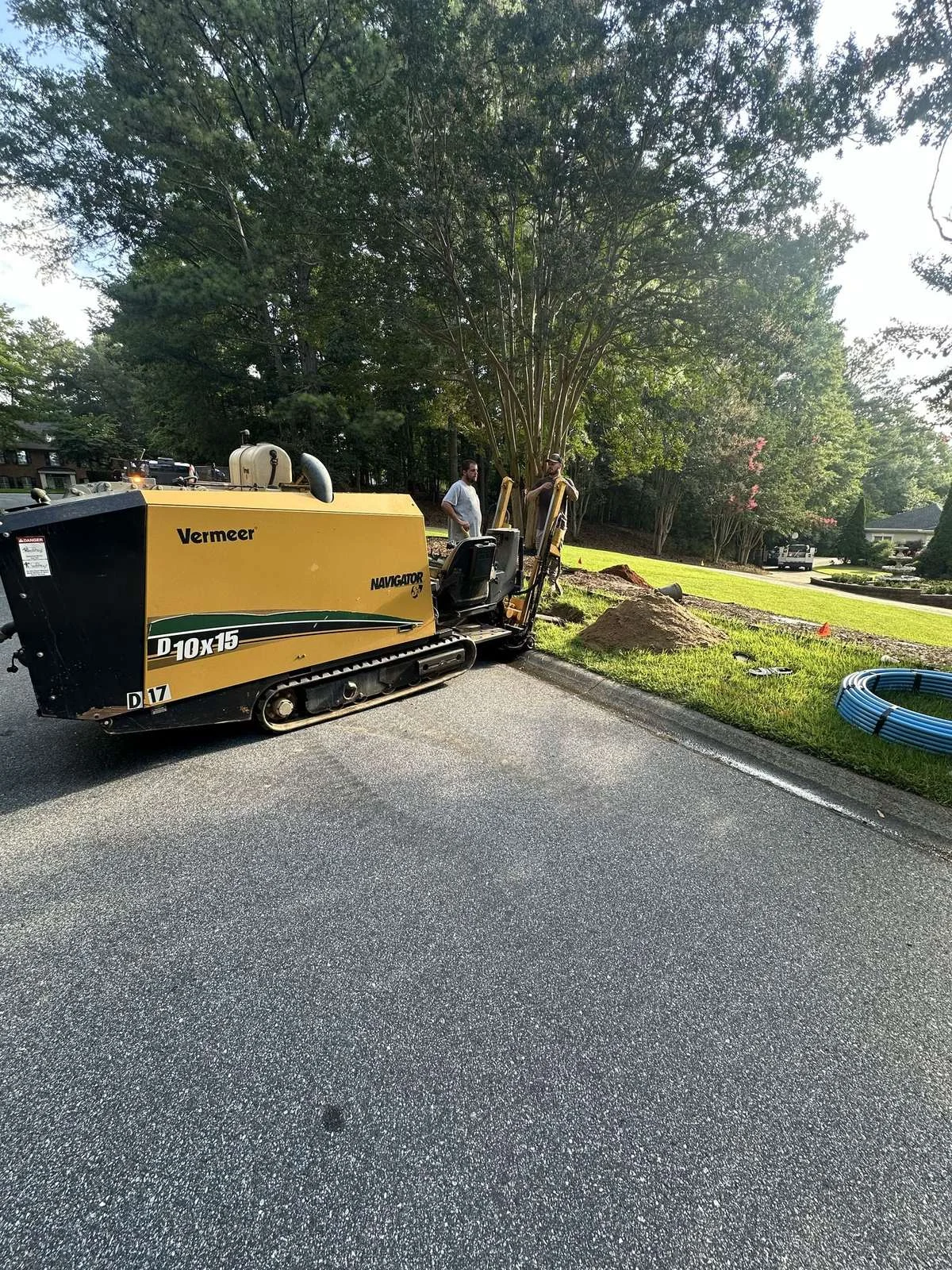
When an old galvanized or polybutylene service line has to go, the traditional fix is a trench from the meter to the house. On many yards there is a better option: a new line pulled or bored underground between two small access pits, so the grass, the driveway and the shrubs along the way stay where they are.
It is not right for every property. Long runs, rock, a line that bends around obstacles, or other utilities crowded along the same path can make a short, careful trench the better job. We look at the run first and tell you which approach fits before any digging starts.
Who owns which part of the water line
Your water provider owns the main in the street, the tap into it, the short line to the meter, and the meter itself. From the meter to your house, the service line belongs to you. Spartanburg Water states plainly that residents are responsible for the maintenance and repair of the service lines on their property that connect their homes to its system.
The same general split applies with the other water providers in our area, including Startex-Jackson-Wellford-Duncan Water District, Inman Campobello Water District, the Gaffney Board of Public Works. If water is leaking on the street side of the meter or at the meter itself, call your water provider. If it is leaking on the house side, call a plumber.
Old galvanized and poly service lines
The age of your service line says a lot about how it will fail. Older homes often have galvanized steel lines that rust from the inside. The pipe narrows until the pressure drops, then it starts to leak, often at a threaded joint.
Some homes from the 1980s and early 1990s have polybutylene service lines, which are prone to sudden failure. Newer homes usually have PE (polyethylene) or PVC, which last much longer. When we replace a service line, we use modern plastic pipe rated for buried water service, bedded properly so rocks do not wear through it.
Repair a section or replace the line
A single break in a line that is otherwise in good shape, such as a cracked fitting or a section hit by a fence post or a root, gets a spot repair. We dig at the leak, cut out the damaged pipe and couple in new.
When the line is old galvanized or polybutylene, or has already been patched before, replacing it from the meter to the house is usually the better use of your money. A new line is laid in a trench, or sometimes pulled or bored under a driveway or walk to avoid tearing it up. You get full pressure back, and you are not paying for the next dig in a year.
Installing a new water line
A new service line is not only a replacement job. Homes that are giving up a well for public water, new meters for a shop, barn or second building, and lines moved out from under a planned driveway or addition all start with a new run from the meter.
The water provider sets the tap and the meter, and its own rules decide where the meter goes and what fittings it wants on the customer side. Once the meter is in, we trench from it to the house shutoff, lay pipe rated for buried water service in clean bedding below where it can freeze, and bring it through the foundation to a full-port shutoff valve inside.
With plastic pipe we also lay a tracer wire or locating tape in the trench, because SC811 will not mark a private line and the next person digging needs a way to find it. The new line is pressure-checked with the water on and the meter watched before the trench is closed.
Pressure: too low or too high
Low pressure all through the house often traces back to a narrowed galvanized service line, a partly closed valve, or a leak.
High pressure is a problem too. The plumbing code requires a pressure-reducing valve (PRV) where the static water pressure is over 80 psi. Too much pressure wears out faucets, toilet valves and water heaters. A PRV also wears out over time, and a failing one can let pressure creep up or cut it down. We can test your pressure with a gauge and repair or replace the PRV.
How a water line repair goes
-
Confirm it is the service line
We use the meter test with the house shutoff closed to confirm the leak is in the yard, not inside the house.
-
Locate the line
We call SC811 to have utility lines marked before we dig. The 811 marks stop at the meter, so we locate your own service line as well.
-
Dig and expose
We dig at the leak, or trench the route for a replacement, with care around other lines and your landscaping.
-
Repair or replace
We cut out and couple in new pipe, or lay a new line from the meter to the house shutoff.
-
Test and backfill
With the water on, we check the joints and watch the meter before backfilling and tamping the trench.
Not sure this is the problem? Describe what is happening and we will tell you.
(864) 415-7482Permits for service line work
Replacing a water service line is generally permitted work, and some water providers also have requirements for the connection at the meter. A small spot repair usually is not. We tell you what applies to your address and handle the permit with the city or county building department.
What drives the cost of water line repair
Every job is priced before work starts. These are the things that move the number.
- Repair or replace
- One section is a repair. A full run from the meter to the house is a bigger job.
- Length and depth
- A longer distance from the meter to the house means more trench and more pipe.
- What is in the way
- Driveways, walks, patios, trees and landscaping change the route and the method.
- Soil and rock
- Upstate red clay digs slowly when it is wet, and rock adds time.
Why homeowners call Gas Guys for water lines
We dig our own jobs
Yard pipe digs are work we do ourselves. Reviews mention it.
Honest about repair vs replace
If one spot repair will hold, we will tell you. If the line is done, we will show you why.
We put the yard back
Trenches are backfilled and tamped, not left as a ditch.
Answered 24/7
A broken service line can leave you with no water. Call any hour.