Running a grill off the house gas means never swapping a propane cylinder halfway through a cookout. A fire pit or fire table on a gas line lights with a switch and leaves no ash. That is why outdoor gas is one of the most common additions to a patio or a new deck.
Outdoor lines have their own rules. Most of the run is underground, in plastic pipe that cannot be exposed to sunlight and has to be buried at a set depth with a tracer wire so it can be found later. Where it comes up, it transitions to steel. Each appliance needs a shutoff you can reach, and portable grills need a listed quick-disconnect.
We plan the route around your patio, landscaping and future plans, size the line for everything outside and inside, and leave you with a line that is tested, inspected, and easy for the next person to locate.
- Piedmont Natural Gas Advantage Partner
You might want an outdoor gas line if
- You are tired of refilling propane cylinders for the grill
- You are building an outdoor kitchen, a covered patio or a pergola
- You want a gas fire pit, fire table or patio heater
- You are adding a deck or a patio and want gas there before the surface goes down
- You have a pool or spa and are thinking about a gas heater
- Your current outdoor line is old buried steel, or nobody knows where it runs
Outdoor appliances we run gas to
- Freestanding gas grills
- Built-in grills and outdoor kitchens
- Side burners, griddles and pizza ovens
- Fire pits and fire tables
- Fire bowls and outdoor fireplaces
- Patio heaters
- Pool and spa heaters
- Gas lanterns
Underground: polyethylene pipe and tracer wire
The standard for buried gas lines is yellow polyethylene (PE) pipe. It does not corrode like buried steel, it handles shifting soil, and it can be run in long lengths with few joints. It is rated for use underground only, so it never runs exposed to sunlight or inside a building.
The fuel gas code sets a minimum burial depth of 12 inches, with a reduced 8 inches allowed for a line feeding an individual outdoor appliance like a grill or a lantern. We often go deeper where the line crosses a lawn that will be aerated, a garden bed that will be tilled, or ground that might see a fence post or a sprinkler line later. Rocks and debris stay out of the backfill around the pipe.
Because plastic pipe cannot be found with a metal detector, the code requires a tracer wire buried alongside it. That wire is how a locator finds your line years later. Since SC811 will not mark it, the tracer wire and the notes we leave you on the route are what keep a future fence crew or landscaper from hitting it.
Risers, shutoffs and quick-disconnects
Where the line comes out of the ground, it transitions from PE to steel through a riser. Factory risers have the transition built in and a protective coating where the pipe passes through soil, which is the zone where bare steel corrodes fastest. The riser is anchored to something solid, such as the kitchen frame, a post or the house wall, so it is not bumped loose.
Every outdoor appliance gets an accessible manual shutoff valve. For a built-in grill or a fire table, it is near the appliance and reachable without taking the island apart; access panels and doors in an outdoor kitchen are planned for it.
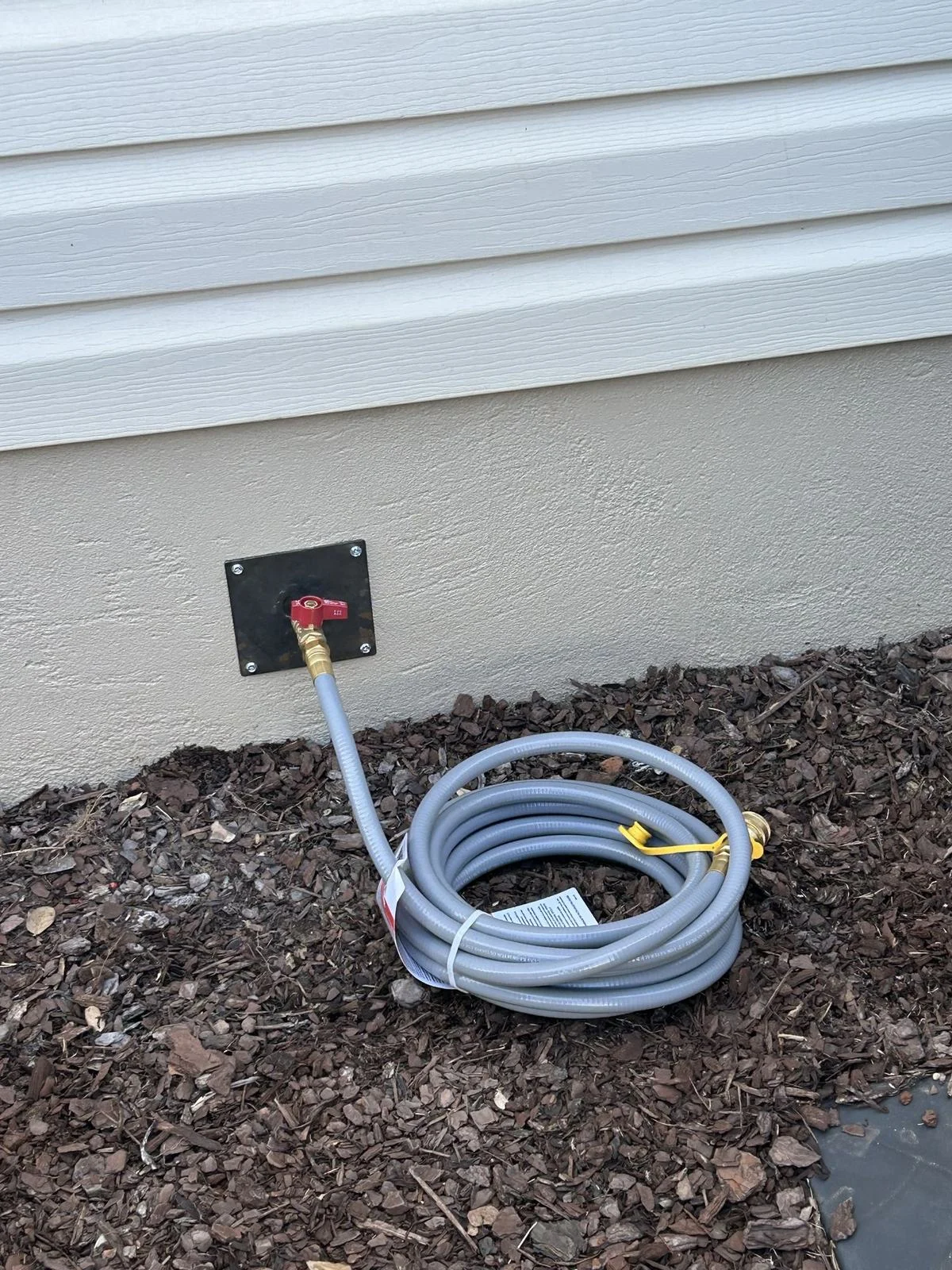
A freestanding grill that rolls around the patio connects with a listed quick-disconnect coupling and a hose made for outdoor gas appliances. The code requires a manual shutoff upstream of the quick-disconnect, and the coupling shuts off automatically when the grill is unhooked. That lets you move the grill to clean or store it without leaving an open gas line.
Grills, fire pits and fire tables on natural gas
Most grills sold off the floor are set up for propane cylinders. To run one on natural gas it needs the manufacturer's natural gas version or conversion kit, which changes the burner orifices and removes the propane regulator. Some models offer no conversion at all, so check before you buy. A grill running on the wrong fuel burns poorly and can flare dangerously.
Fire pits and fire tables are listed for one fuel too, and they come with a manufacturer's minimum supply pressure and a BTU rating that can be higher than people expect. A large fire table can draw as much as a furnace. We size the line from the rating plate and check the flame height and pattern on startup.
Placement matters as much as the gas. Grills and fire features have listed clearances to combustible walls, railings and overhead structures. A grill tucked under a low covered porch, or a fire table under a pergola with a solid roof, has to meet the clearances in its manual.
Planning the route and the load
The best time to run an outdoor gas line is before the patio, the pavers or the deck go down. A sleeve under a new patio costs little to place during construction and saves cutting concrete later. If you think you will want a fire table next year, it is far easier to stub a capped line to that spot now.
Outdoor appliances add to the house load. A grill, a side burner and a fire table together can be a meaningful draw, and a pool heater is often the largest gas appliance on the property. We size the outdoor branch and check that the line back toward the meter can carry it with the furnace and water heater running.
Where the line starts matters too. A tie-in near the meter, a branch in the crawlspace, or a connection at the house wall each have trade-offs in length, digging and how much of the existing piping has to be upsized. We walk the yard with you and lay out the route before we dig.
How an outdoor gas line install runs
-
Walk the yard
We look at where each appliance will go, the best tie-in point, and what the line has to cross: lawn, beds, walks, drives or future hardscape.
-
Size and permit
We add up the outdoor and indoor load, size the pipe, and pull the permit for the address.
-
Locate and dig
SC811 marks utility lines, we account for any private lines, and we trench to the planned depth.
-
Lay pipe and tracer wire
PE pipe in clean backfill with tracer wire alongside, transitioning to steel through a coated riser at each appliance.
-
Test and inspect
The new line is pressure-tested to the fuel gas code minimum with no drop allowed, and inspected before backfill is finished.
-
Connect and light
Shutoffs, quick-disconnects and appliance connections are installed, leak-checked under gas, and each appliance is lit and checked.
Not sure this is the problem? Describe what is happening and we will tell you.
(864) 415-7482Permits for outdoor gas lines
A new gas line to an outdoor appliance is gas piping, and it is permitted and inspected the same as a line inside the house. Inside the City of Spartanburg the city building department issues it; outside city limits it is Spartanburg County or Cherokee County, or a city that permits within its own limits.
The inspector typically wants to see the pipe, the tracer wire and the test before the trench is closed, so we schedule the inspection around the dig. Homeowners associations sometimes have their own rules on fire features and outdoor kitchens, so check those before the design is final.
What drives the cost of an outdoor gas line
Every job is priced before work starts. These are the things that move the number.
- Length of the run
- Distance from the tie-in to each appliance sets the amount of trench and pipe.
- What the line crosses
- Open lawn is straightforward. Driveways, walks, patios, roots and Upstate clay and rock slow the trench or call for boring.
- Number of appliances
- Each grill, fire feature or heater adds a riser, a shutoff and a connection.
- Total load
- A pool heater or large fire table may require a larger outdoor line, or upsizing part of the house piping.
- Conversions
- Grills and fire features bought for propane need the manufacturer's natural gas kit, where one exists.
- Permit and inspection
- Fees are set by the city or county, and the inspection has to happen before the trench is closed.
Who supplies gas in your town
Your utility owns the main and the meter and handles gas emergencies at the meter. Everything after the meter is yours, and that is the piping we install and repair.
| Town | Natural gas | Permits |
|---|---|---|
| Spartanburg | Piedmont Natural Gas | City of Spartanburg Building Inspections; Spartanburg County Building Codes outside city limits |
| Boiling Springs | Piedmont Natural Gas | Spartanburg County Building Codes |
| Inman | Piedmont Natural Gas | City of Inman (processed by SAFEbuilt) |
| Chesnee | Piedmont Natural Gas or propane | Cherokee County Building Safety, after City of Chesnee zoning approval |
| Cowpens | Piedmont Natural Gas | Town of Cowpens (building safety by CC&I Services) |
| Gaffney | Piedmont Natural Gas | City of Gaffney Community Development; Cherokee County Building Safety outside city limits |
| Duncan | Greer CPW | Town of Duncan |
| Wellford | Greer CPW | City of Wellford |
| Lyman | Greer CPW | Town of Lyman zoning approval, then CC&I Services |
| Moore | Varies: Piedmont, Greer CPW or propane | Spartanburg County Building Codes |
| Woodruff | Piedmont Natural Gas | City of Woodruff Building Department |
| Landrum | Greer CPW | City of Landrum (start at City Hall); Spartanburg County Building Codes outside city limits |
| Campobello | Mostly propane (no gas main confirmed) | Spartanburg County Building Codes (confirm with Campobello Town Hall) |
| Roebuck | Piedmont Natural Gas | Spartanburg County Building Codes |
| Pacolet | City of Union (Union Gas) | Town of Pacolet, through its contracted building inspection firm |
| Converse | Piedmont Natural Gas | Spartanburg County Building Codes |
| Fairforest | Piedmont Natural Gas | Spartanburg County Building Codes |
| Startex | Greer CPW or Piedmont (check your bill) | Spartanburg County Building Codes |
| Reidville | Greer CPW | Town of Reidville (zoning approval, then CC&I for permits); Spartanburg County outside town limits |
| Arcadia | Piedmont Natural Gas | Spartanburg County Building Codes |
| Clifton | Piedmont Natural Gas | Spartanburg County Building Codes |
| Drayton | Piedmont Natural Gas | Spartanburg County Building Codes |
| Fingerville | Propane in most homes; check for Piedmont service | Spartanburg County Building Codes |
| Glendale | Piedmont Natural Gas (where mains reach) | Spartanburg County Building Codes |
| Gramling | Varies: propane or natural gas, by road | Spartanburg County Building Codes |
| Greer | Greer CPW | City of Greer Building and Development Standards (inside city limits) |
| Holly Springs | Varies: Greer CPW, Piedmont or propane | Spartanburg County Building Codes |
| Mayo | Varies: Piedmont where mains run, propane elsewhere | Spartanburg County Building Codes |
| Pacolet Mills | City of Union (Union Gas); confirm on your bill | Town of Pacolet, through its contracted building inspection firm |
| Pauline | Varies: Piedmont where mains run, propane elsewhere | Spartanburg County Building Codes |
| Southern Shops | Piedmont Natural Gas | Spartanburg County Building Codes |
| Una | Piedmont Natural Gas | Spartanburg County Building Codes |
| Whitestone | Varies: Piedmont where mains run, propane elsewhere | Spartanburg County Building Codes |
| Chimney Rock | Propane (no gas main) | Rutherford County Building Inspections (village zoning permit first) |
| Lake Lure | Propane (no gas main) | Rutherford County Building Inspections (Town of Lake Lure zoning permit first) |
| Forest City | Enbridge Gas North Carolina | Town of Forest City Building Inspections |
| Rutherfordton | Enbridge Gas North Carolina | Rutherford County Building Inspections (town zoning permit first for additions) |
| Spindale | Enbridge Gas North Carolina | Rutherford County Building Inspections (town zoning permit first for additions) |
| Union Mills | Mostly propane | Rutherford County Building Inspections |
| Mill Spring | Enbridge Gas North Carolina (limited); propane elsewhere | Polk County Building Inspections |
| Tryon | Enbridge Gas North Carolina | Polk County Building Inspections (Town of Tryon zoning permit first) |
| Columbus | Enbridge Gas North Carolina | Polk County Building Inspections (Town of Columbus zoning permit first) |
| Green Creek | Mostly propane | Polk County Building Inspections |
Utility territories have edges, and rural homes past the mains run on propane. Check your bill if you are unsure.
Why call Gas Guys for outdoor gas
Built to be found later
Tracer wire on every buried plastic line, and a clear record of the route, because 811 will not mark it for you.
Sized for the whole property
We count the indoor appliances along with the grill and fire table so nothing starves on a cold night.
Right fuel, right flame
We confirm each appliance is set up for natural gas before it is connected, and check the flame on startup.
Planned with your project
We work ahead of the patio or deck crew so the line and sleeves are in before the surface goes down.