Most gas line repairs are not dramatic. A union under the water heater has started to weep, an outdoor riser has rusted thin where it meets the dirt, or a home inspector flagged an old brass connector behind the range. Sometimes it is louder than that: a fence post auger or a trencher finds a buried line nobody knew was there.
Either way the goal is the same. Find the actual defect, cut it out, replace it with the right material for that spot, and prove the whole system is tight with a pressure test before anything gets relit. Gas piping is not patched. Tape, epoxy and leak sealants have no place on a gas line, and the fuel gas code expects damaged pipe and fittings to be replaced, not wrapped.
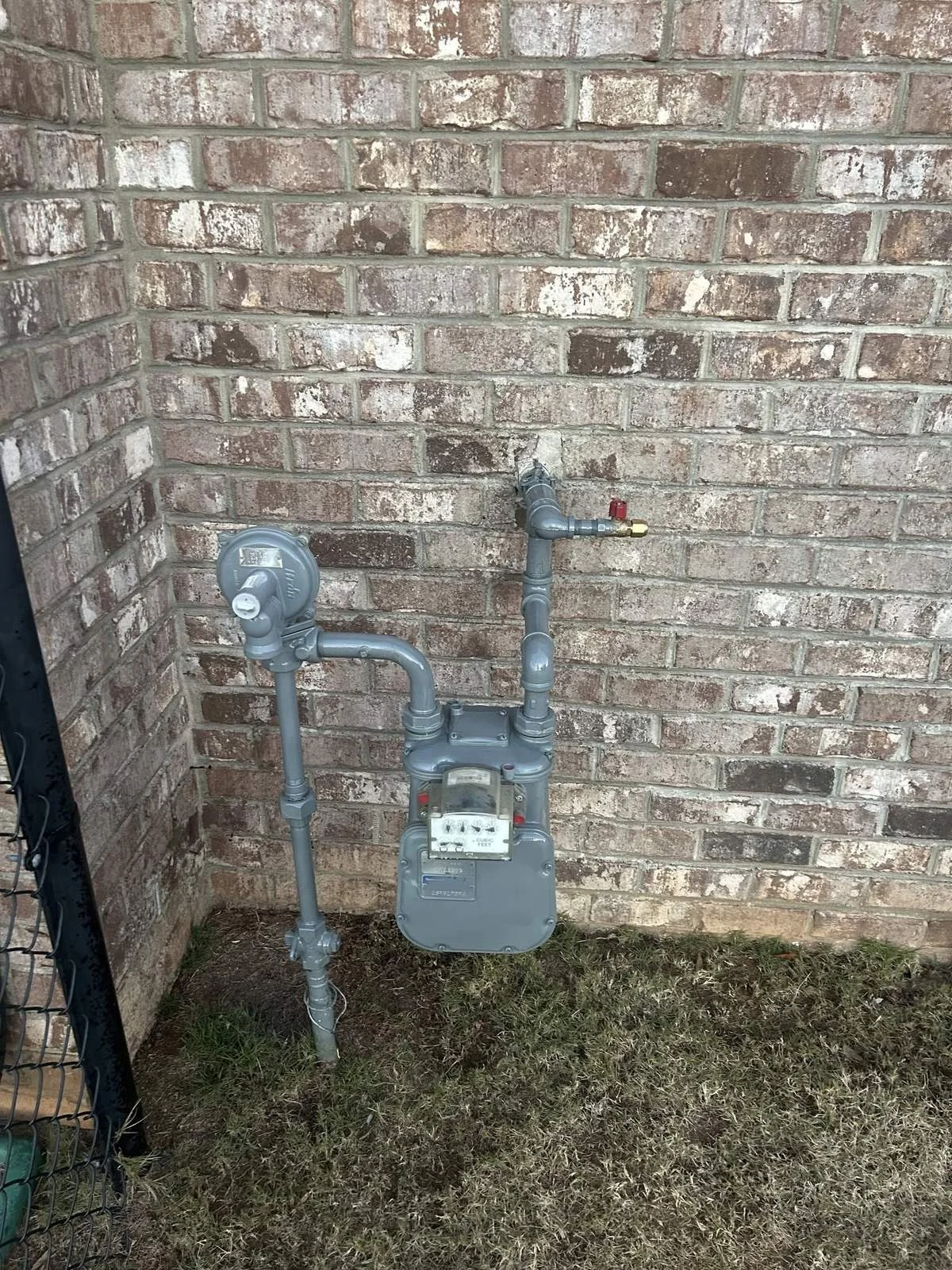
Everything from the outlet of the meter to your appliances is customer-owned piping. The gas utility maintains its main, its service line and the meter, and your piping is yours to keep in safe repair. That is the part we work on.
If you smell gas right now, stop reading and get outside. Call the utility or 911 from a safe distance first, and call us once the utility has made it safe.
- Piedmont Natural Gas Advantage Partner
Signs your gas piping needs repair
- A faint rotten-egg smell near the meter, the water heater, the furnace or behind the range
- Bubbles in a soap test at a union, valve or threaded joint
- Flaking, pitted or swollen rust on black steel pipe in a crawlspace or on an outdoor riser
- An old uncoated brass flex connector, or any connector that has been kinked, crushed or run through a wall
- A gas bill that climbs while your use has not changed
- A buried line that was nicked, pulled or broken while digging
- A red tag left by the gas utility on an appliance or a section of pipe
Where gas line repairs usually happen
- Unions and valves at the water heater and furnace
- Range and dryer connectors behind the appliance
- Black steel pipe in damp crawlspaces
- Outdoor risers coming out of the ground at the house wall
- Buried lines to a detached garage, shop, grill or pool heater
- Drops through floors and walls where the pipe was never sleeved
- Gas log valves and fireplace supply lines
- Lines damaged during remodels, decks and fence work
Why gas piping fails in Upstate homes
Black steel pipe lasts a long time indoors and dry. The trouble spots are where it is not dry. A crawlspace that floods every spring, a pipe resting on a wet sill or a masonry pier, or a line strapped against an exterior wall where rainwater runs down will rust from the outside in. The pipe looks solid until a wire brush goes through it.
Threaded joints are the other common failure. Unions and fittings near appliances get bumped, torqued when a water heater is swapped, or were made up years ago with dried-out compound. They tend to leak slowly, a smell that comes and goes rather than a hiss, which is why many of them go unnoticed for months.
Then there is age. Older homes around Spartanburg can carry a mix of original steel, later additions in different materials, and connectors that predate current standards. A repair is a good moment to look at the rest of the line, not just the joint that leaked.
Old flex connectors and leaking unions
The flexible tube between the shutoff valve and the appliance is a connector, not piping, and it has rules of its own. It has to be listed for gas, sized for the appliance, kept to the length the manufacturer allows, and it cannot run through a wall, floor, ceiling or the appliance housing. A connector that gets pushed back and forth every time the dryer moves eventually fatigues and cracks.
Some older connectors are uncoated brass, and the consumer safety agencies have warned for decades that their flare fittings can separate. If you find a dull brass-colored tube behind an old range or dryer, replace it rather than reuse it. A new coated stainless connector is a small part and a big improvement.
Leaking unions get taken apart, cleaned and remade, or replaced outright if the seat is damaged. We do not crank on a leaking union until it stops bubbling; overtightened fittings crack and fail later.
Rusted outdoor risers and buried lines
Where a gas line comes out of the ground and turns up the house wall, the pipe sits in damp soil, mulch and splashback from every storm. That few inches at grade is where steel corrodes fastest. If the riser has heavy scale or pitting at the soil line, it gets replaced, usually with a factory riser that has a protective coating and a built-in transition from buried plastic.
Buried steel lines from decades ago are a bigger question. Bare or poorly wrapped steel in the ground corrodes along its whole length, and a single leak is often a sign of more to come. In many cases the right repair is to abandon the old line and run new polyethylene pipe with a tracer wire, which does not rust and can be located later.
If a line was cut or crushed while digging, the damaged section and any stressed fittings nearby are replaced, and the whole line is tested. A pipe that was yanked can crack a fitting several feet away from where the shovel hit.
Who repairs what: utility side and your side
Your gas utility owns the main, the service line to the meter, and the meter and regulator assembly. If the leak is on that equipment, the utility repairs it, and you should call them. In most of Spartanburg County that is Piedmont Natural Gas, and Greer CPW serves the Duncan, Lyman and Wellford area.
Piedmont's South Carolina service regulations put the customer's piping and equipment, from the meter assembly onward, on the customer to keep in good and safe repair. That covers every foot of pipe to every appliance, above ground and buried. That is the work a licensed contractor does.
SC811 is free and required before you dig, but it only marks utility-owned lines up to the meter. Your buried line to a shop or a grill is not marked. If you are planning a fence, a patio or a garden bed near where gas might run, ask us first and we can help work out where it is.
How a gas line repair runs
-
Make it safe
If there is an active leak we shut the gas at the nearest valve or at the meter, ventilate, and confirm with a detector that the area is clear before any work starts.
-
Find every defect, not just the first
We check the suspect joint and the rest of the accessible system with an electronic detector and leak solution, and look over the pipe condition, supports and connectors.
-
Explain the options
Repair one fitting, replace a section, or rerun a line that is past saving. You get the reasons for each, in plain terms, before we cut anything.
-
Replace, do not patch
Damaged pipe and fittings are cut out and replaced with the right material for that spot: steel indoors, coated risers at grade, polyethylene with tracer wire underground.
-
Pressure test
The repaired piping is tested to the fuel gas code minimum of one and a half times working pressure, never less than 3 psi, for at least 10 minutes, and it has to hold with no drop.
-
Purge, relight and check
We purge air from the line, relight every appliance that was shut off, and check each burner and connection before we leave.
Not sure this is the problem? Describe what is happening and we will tell you.
(864) 415-7482Do gas line repairs need a permit
It depends on the scope and the jurisdiction. Replacing a section of piping, rerunning a buried line or relocating a line is generally permitted work, issued by the City of Spartanburg inside city limits or by the county building codes office outside them. Cherokee County, and cities that run their own permitting, have their own offices.
Smaller repairs, like swapping a connector on an existing appliance, are treated differently from place to place. We check with the office that covers your address and pull the permit when one is required. If the utility shut off and locked the meter, it will typically want the repair inspected and tested before it turns gas back on.
What affects the cost of a gas line repair
Every job is priced before work starts. These are the things that move the number.
- Where the defect is
- A union in an open utility room is quick to reach. The same leak inside a finished wall, under a slab or in a tight crawlspace takes far longer.
- Repair or replace
- A single fitting is a small job. Pipe that is corroded along its length, or a buried steel line with repeated leaks, is better replaced than chased one leak at a time.
- Digging
- Underground repairs mean locating the line, hand-digging around it and restoring the ground afterward. Depth, roots and hardscape all add time.
- How much of the system is involved
- A repair that requires shutting the whole house down means retesting and relighting every appliance, not just the one on the leaking branch.
- Permit and inspection
- When the repair is permitted work, the fee is set by the city or county and the timing depends on the inspector's schedule.
- After-hours calls
- We answer around the clock. Whether a repair happens at night or is made safe and finished in daylight depends on the leak and on what is open for parts.
Who supplies gas in your town
Your utility owns the main and the meter and handles gas emergencies at the meter. Everything after the meter is yours, and that is the piping we install and repair.
| Town | Natural gas | Permits |
|---|---|---|
| Spartanburg | Piedmont Natural Gas | City of Spartanburg Building Inspections; Spartanburg County Building Codes outside city limits |
| Boiling Springs | Piedmont Natural Gas | Spartanburg County Building Codes |
| Inman | Piedmont Natural Gas | City of Inman (processed by SAFEbuilt) |
| Chesnee | Piedmont Natural Gas or propane | Cherokee County Building Safety, after City of Chesnee zoning approval |
| Cowpens | Piedmont Natural Gas | Town of Cowpens (building safety by CC&I Services) |
| Gaffney | Piedmont Natural Gas | City of Gaffney Community Development; Cherokee County Building Safety outside city limits |
| Duncan | Greer CPW | Town of Duncan |
| Wellford | Greer CPW | City of Wellford |
| Lyman | Greer CPW | Town of Lyman zoning approval, then CC&I Services |
| Moore | Varies: Piedmont, Greer CPW or propane | Spartanburg County Building Codes |
| Woodruff | Piedmont Natural Gas | City of Woodruff Building Department |
| Landrum | Greer CPW | City of Landrum (start at City Hall); Spartanburg County Building Codes outside city limits |
| Campobello | Mostly propane (no gas main confirmed) | Spartanburg County Building Codes (confirm with Campobello Town Hall) |
| Roebuck | Piedmont Natural Gas | Spartanburg County Building Codes |
| Pacolet | City of Union (Union Gas) | Town of Pacolet, through its contracted building inspection firm |
| Converse | Piedmont Natural Gas | Spartanburg County Building Codes |
| Fairforest | Piedmont Natural Gas | Spartanburg County Building Codes |
| Startex | Greer CPW or Piedmont (check your bill) | Spartanburg County Building Codes |
| Reidville | Greer CPW | Town of Reidville (zoning approval, then CC&I for permits); Spartanburg County outside town limits |
| Arcadia | Piedmont Natural Gas | Spartanburg County Building Codes |
| Clifton | Piedmont Natural Gas | Spartanburg County Building Codes |
| Drayton | Piedmont Natural Gas | Spartanburg County Building Codes |
| Fingerville | Propane in most homes; check for Piedmont service | Spartanburg County Building Codes |
| Glendale | Piedmont Natural Gas (where mains reach) | Spartanburg County Building Codes |
| Gramling | Varies: propane or natural gas, by road | Spartanburg County Building Codes |
| Greer | Greer CPW | City of Greer Building and Development Standards (inside city limits) |
| Holly Springs | Varies: Greer CPW, Piedmont or propane | Spartanburg County Building Codes |
| Mayo | Varies: Piedmont where mains run, propane elsewhere | Spartanburg County Building Codes |
| Pacolet Mills | City of Union (Union Gas); confirm on your bill | Town of Pacolet, through its contracted building inspection firm |
| Pauline | Varies: Piedmont where mains run, propane elsewhere | Spartanburg County Building Codes |
| Southern Shops | Piedmont Natural Gas | Spartanburg County Building Codes |
| Una | Piedmont Natural Gas | Spartanburg County Building Codes |
| Whitestone | Varies: Piedmont where mains run, propane elsewhere | Spartanburg County Building Codes |
| Chimney Rock | Propane (no gas main) | Rutherford County Building Inspections (village zoning permit first) |
| Lake Lure | Propane (no gas main) | Rutherford County Building Inspections (Town of Lake Lure zoning permit first) |
| Forest City | Enbridge Gas North Carolina | Town of Forest City Building Inspections |
| Rutherfordton | Enbridge Gas North Carolina | Rutherford County Building Inspections (town zoning permit first for additions) |
| Spindale | Enbridge Gas North Carolina | Rutherford County Building Inspections (town zoning permit first for additions) |
| Union Mills | Mostly propane | Rutherford County Building Inspections |
| Mill Spring | Enbridge Gas North Carolina (limited); propane elsewhere | Polk County Building Inspections |
| Tryon | Enbridge Gas North Carolina | Polk County Building Inspections (Town of Tryon zoning permit first) |
| Columbus | Enbridge Gas North Carolina | Polk County Building Inspections (Town of Columbus zoning permit first) |
| Green Creek | Mostly propane | Polk County Building Inspections |
Utility territories have edges, and rural homes past the mains run on propane. Check your bill if you are unsure.
Why call Gas Guys for gas line repair
We find the cause
A leak at a fitting is often a symptom of a sagging line, a bad support or a corroding run. We look past the bubble to why it is there.
No sealant shortcuts
We replace defective pipe and fittings. It is what the code expects, and it is the only repair that lasts.
Tested before it is lit
Every repair is pressure-tested and every appliance is relit and checked. You are not left with a pilot to light yourself.
Someone answers at any hour
Gas problems do not keep office hours. Call day or night and a person picks up.