A great many Boiling Springs homes came with a gas fireplace already in the living room. Builders in the 1990s and 2000s commonly framed in a factory-built firebox, ran a gas line to it and set a basic log set, vented or vent-free, before the house closed.
Twenty or more years later, those original sets are showing their age. The logs crumble, the burner ports clog, the pilot gets fussy, and the remote that came with the house has long since disappeared. Some homeowners want them fixed. Others want a better set.
We do both. We service the burner, pilot, valve and controls, run new gas lines where a fireplace never had one, and install replacement sets that match your firebox and your gas, whether that is Piedmont natural gas or propane from a tank.
Because so many homes here were built in the same years, the same handful of problems turn up again and again. That makes most service calls straightforward, as long as we know what type of set and firebox you have.
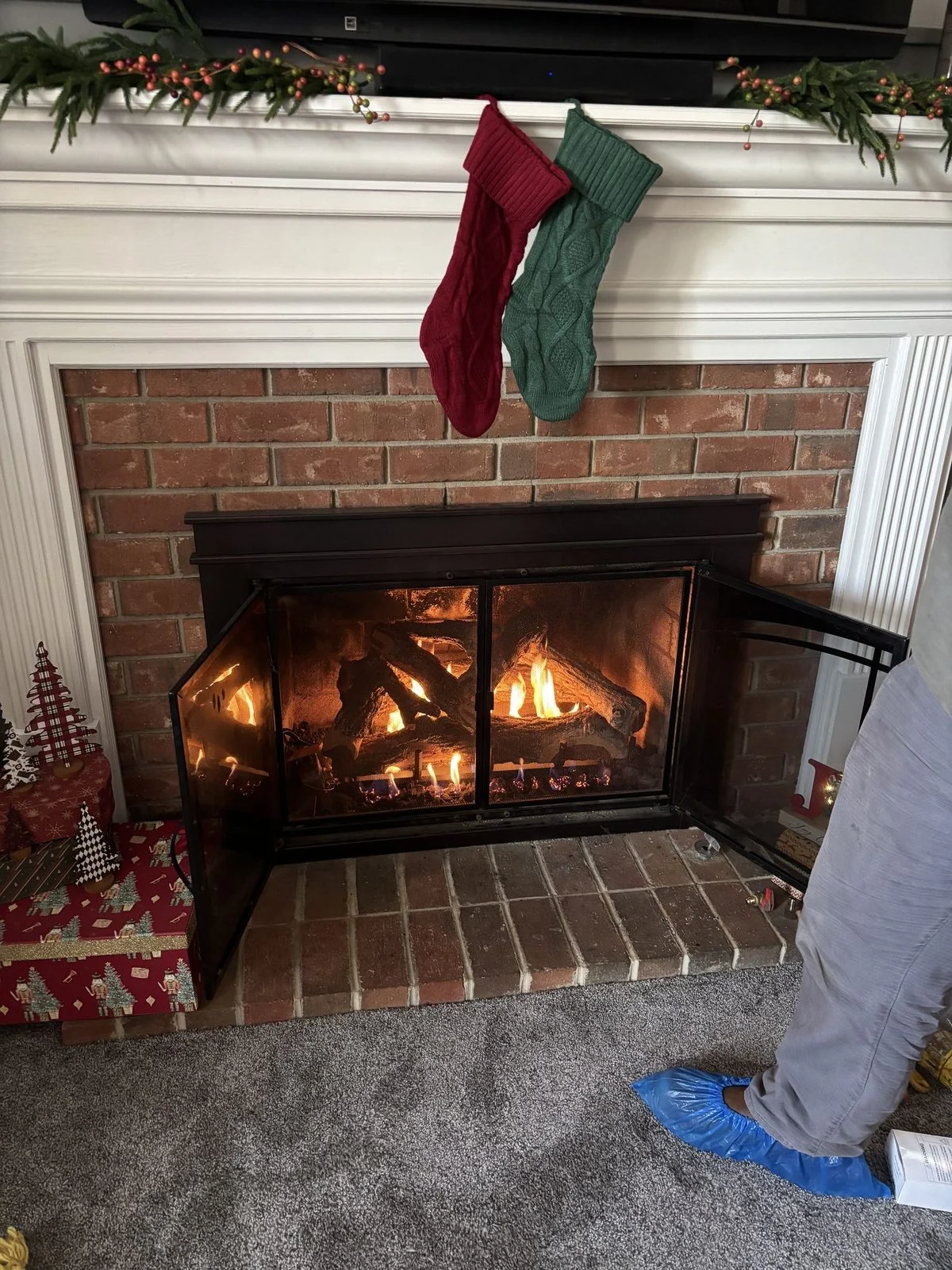
Factory-built fireplaces have rules
A factory-built fireplace is a listed metal box with its own chimney system, not a masonry fireplace. It is tested with particular log sets or types, and its label says what is allowed inside it. Putting an unlisted set in one can void the listing and overheat the firebox.
Before we recommend a new set, we find the fireplace's label, usually inside the opening or behind the lower grille, and match the logs to it.
Factory-built units also have their own metal chimney pipe, often boxed into a chase on the outside wall. A vented set depends on that pipe staying intact and clear, so we look for signs of damage, nesting or water intrusion while we are there.
Vent-free sets in tight newer houses
Newer homes are built tighter than old ones, which keeps heat in and also keeps combustion products in. A vent-free set in a closed family room can drop the oxygen level enough over a long evening to trip its oxygen depletion sensor and shut off.
If your vent-free logs go out after an hour or two, the sensor may be doing its job, or its pilot may be dirty and tripping early. We clean and test it, check the room size against the set's label, and explain the run-time limits.
Propane logs versus natural gas logs
Homes without a Piedmont main often run their logs on propane. Propane and natural gas sets use different orifices, pilots and pressures, and parts are not interchangeable. If a house switched from propane to natural gas, or the other way, the log set must have been converted with the manufacturer's kit or replaced.
We check the rating label against the fuel you are burning on every call. A mismatch shows up as a flame that is too tall, too weak or sooty.
When to replace an original set
Ceramic logs from a builder-grade set slowly crack and crumble, and the embers break down to dust that can block burner ports. Pilot assemblies and valves for older sets are sometimes discontinued. When the parts bill starts to approach the cost of a new set, replacement is the better answer.
A new set is also a chance to choose differently: a vented set for a more natural flame if the firebox allows it, or a vent-free set for more heat where the room and the listing permit it.
Remotes, switches and dead batteries
Many builder sets run on a millivolt valve with a wall switch, and later owners added a remote receiver. When the burner will not answer, the cause is often small and boring.
- Receiver batteries in the fireplace that died over the summer
- A remote that lost its pairing with the receiver
- A loose wire at the wall switch
- A thermopile too weak to power the valve through the switch
In Boiling Springs specifically
Key valve location
In many newer homes the gas shutoff for the logs is a key valve in the wall beside the hearth, or a valve inside the lower grille. Know where yours is before the season starts.
Permits through the county
A new line or a new appliance installation in Boiling Springs is permitted and inspected by Spartanburg County Building Codes.
Direct-vent units
Some homes have a sealed direct-vent gas fireplace with a glass front. We service the gas side, but the vent system must follow the manufacturer's design exactly.
Carbon monoxide alarms
Any home with a gas fireplace needs working CO alarms near bedrooms and on each level. Check the date on yours; most need replacing after several years.
How a gas log service call goes
-
Tell us what it is doing
Will not light, goes out, burns dirty, shuts off, smells. The symptom points to the part, so a good description saves time.
-
Shut off, cool down, inspect
We turn off the gas at the valve, confirm the set is cool, and look at the logs, burner, pilot, valve and connector before touching anything.
-
Test the controls
We measure thermocouple or thermopile output, check the switch, remote and wiring, and check gas pressure where needed.
-
Clean and repair
The burner, pan, pilot and ODS are cleaned, and worn parts are replaced with ones that match the manufacturer and the gas type.
-
Leak check and relight
Every connection we touched is leak-checked, the logs go back in their correct positions, and we light the set and watch it run.
-
Walk you through it
We show you how to light it, where the shutoff is, and what a correct flame looks like, so you know when something has changed.
The full guide to gas logs sales, installation & service, and everything else about plumbing and gas in Boiling Springs.