Most fireplaces in Duncan's newer subdivisions were gas from the start. Builders set factory-built fireboxes with log sets, or sealed direct-vent units with a glass front, and ran a line from the Greer CPW meter to each one. Wood-burning masonry fireplaces are mostly found in the older homes near Main Street.
That shapes the service work here. Instead of chimneys and old dampers, the usual calls are about electronic ignition, remotes, wall switches, thermopiles and the glass on direct-vent units. The fundamentals are still the same: a pilot or igniter, a safety sensor, a valve and a burner.
We service the gas side of all of it, repair what has failed, install new log sets that fit the firebox listing, and run new lines where a fireplace has none.
If your fireplace sits unused for most of the year, a check before the first cold night is the easiest way to avoid finding a problem with company on the way.
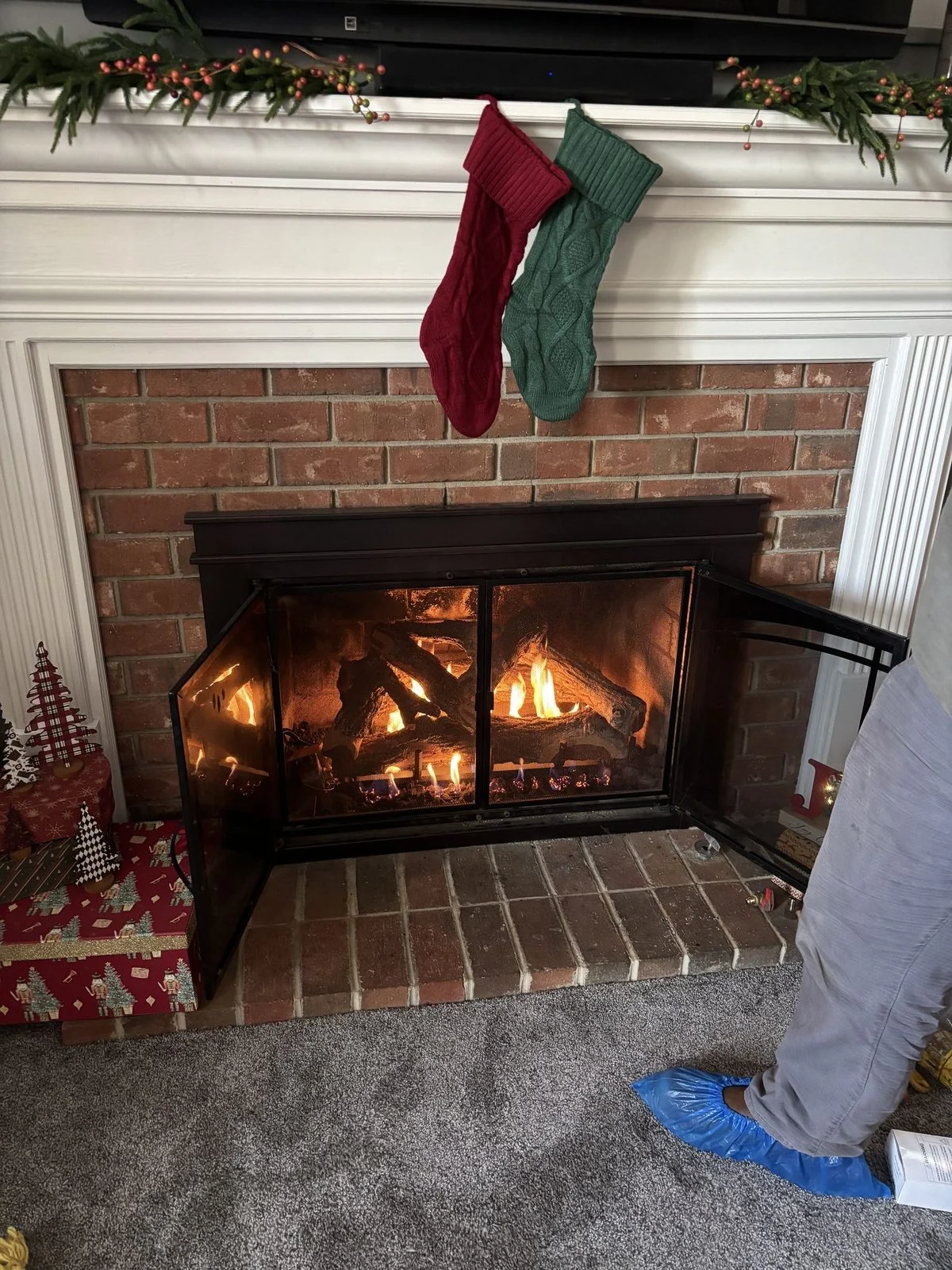
Direct-vent fireplaces
A direct-vent gas fireplace is a sealed box. It pulls combustion air from outdoors and sends exhaust back out through a concentric vent, usually through a wall or the roof. The glass front stays closed when it runs.
We service the burner, pilot or igniter, valve, controls and gas supply. The vent system is part of the manufacturer's listing, and any change to it has to follow their instructions exactly. If the glass is cloudy or the gasket is failing, that is part of the inspection too.
Electronic ignition and remotes
Newer units often use intermittent pilot or electronic ignition rather than a standing pilot. When those do not light, the cause is often electrical: a control module, a battery backup, a receiver that lost its pairing, or a flame sensor that needs cleaning.
- Clicks but will not light: igniter gap, gas supply or flame sensor
- Lights then shuts off: flame sensor or control board fault
- Remote does nothing: receiver batteries or lost pairing
- Nothing at all: power to the unit, the wall switch or the module
Vent-free sets in open floor plans
Some Duncan homes have vent-free logs, which keep their exhaust in the house. Open floor plans give them plenty of room volume, which helps, but the moisture they add still shows up as condensation on cold windows if they run for hours.
Every vent-free set has an oxygen depletion sensor that shuts it down if room oxygen drops. A dirty sensor pilot trips early. We clean it, test it and check that the set is within its room-size limits.
Log placement on a vent-free set is exact. If logs have been moved for cleaning and put back by eye, the flame can hit them and start making soot and carbon monoxide. We reset them to the diagram in the manual.
The yearly check
A sealed fireplace still collects dust, pet hair and the occasional insect in its burner compartment and pilot. Once a year, before the heating season, we shut off the gas, clean the burner and pilot or igniter, check the valve and connector for leaks, and inspect the glass and its gasket.
Then we fire it and watch the flame. A good flame is steady and the right color for the unit. Lazy, sooty or lifting flames mean something is off with the gas supply, the burner or the venting, and the fireplace should not be used until that is found.
Adding or replacing a set
A replacement set has to be one the factory-built fireplace is listed to accept. We find the label, usually inside the firebox or behind the lower grille, and match the logs to it. A brand-new line to a fireplace that has no gas is permitted work through the Town of Duncan, tested and inspected before the logs are lit.
In Duncan specifically
Greer CPW gas
Duncan fireplaces burn Greer CPW natural gas. Homes on propane need propane-specific parts, and the rating label tells us which you have.
Town permits
New gas lines and new appliance installations inside town limits are permitted by the Town of Duncan's building official.
Older masonry fireplaces
Houses near Main Street that predate the newer subdivisions may have wood-burning masonry fireplaces. A vented log set there needs a clean chimney and a damper fixed open.
Carbon monoxide alarms
Keep a working CO alarm on each level and outside bedrooms in any home with a gas fireplace, sealed or not.
How a gas log service call goes
-
Tell us what it is doing
Will not light, goes out, burns dirty, shuts off, smells. The symptom points to the part, so a good description saves time.
-
Shut off, cool down, inspect
We turn off the gas at the valve, confirm the set is cool, and look at the logs, burner, pilot, valve and connector before touching anything.
-
Test the controls
We measure thermocouple or thermopile output, check the switch, remote and wiring, and check gas pressure where needed.
-
Clean and repair
The burner, pan, pilot and ODS are cleaned, and worn parts are replaced with ones that match the manufacturer and the gas type.
-
Leak check and relight
Every connection we touched is leak-checked, the logs go back in their correct positions, and we light the set and watch it run.
-
Walk you through it
We show you how to light it, where the shutoff is, and what a correct flame looks like, so you know when something has changed.
The full guide to gas logs sales, installation & service, and everything else about plumbing and gas in Duncan.