Some of the best fireplaces in the Upstate are in Gaffney's older neighborhoods. Houses in the residential historic district were built between about 1890 and 1930 for mill executives, merchants and professionals, and many have more than one masonry fireplace with an original mantel.
Over the decades, plenty of those fireplaces were fitted with gas logs, and so were the newer homes beyond the old core. Whatever the age of the house, the service calls are about the same parts: the pilot, the sensor that proves the pilot is lit, the valve, the burner and the controls.
We service and repair gas log sets on Piedmont natural gas and on propane, install new sets, and run new lines to fireplaces that never had gas. When a chimney or firebox needs work, we say so and leave it to a sweep or a mason.
The busiest week of the year is the first cold one, when everyone tries their logs at once. Calling in early fall usually means a quicker appointment and a fire that works when you want it.
Old masonry chimneys and vented logs
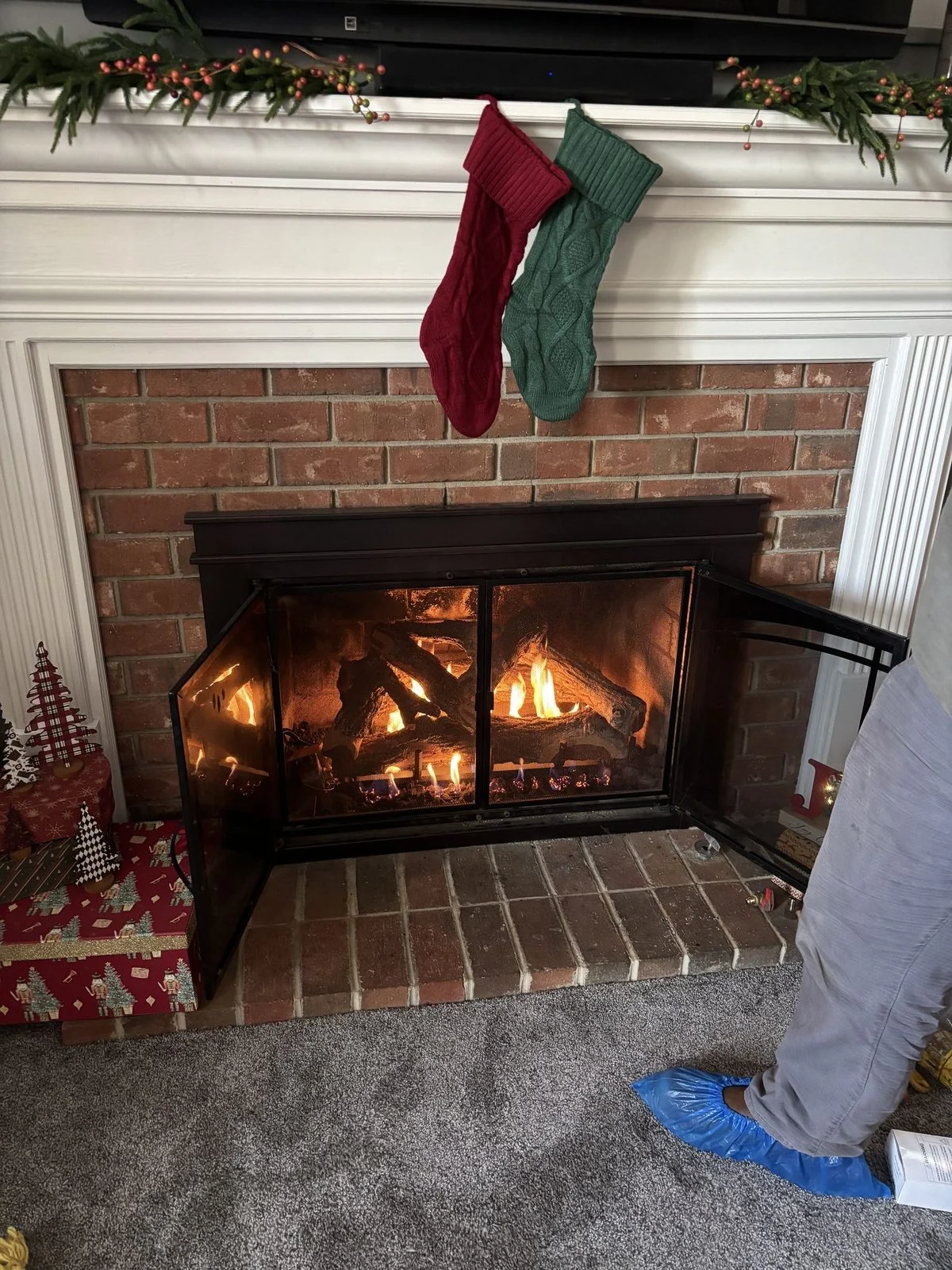
Vented decorative logs send their exhaust up the chimney and burn with a tall, yellow flame that looks like wood. They pair naturally with old masonry fireplaces, as long as the chimney is clear and sound.
The damper on a vented set has to be fixed open, usually with a clamp. In an older house that can mean a draft when the logs are off. We check for the clamp on every visit, and if the draft bothers you, we can talk through a better-fitting set or a sealed insert.
Several fireplaces, several valves
A large old house may have gas stubs at two or three hearths, some in use and some long forgotten. Each one is a valve and a fitting that can seep, and an unused stub left on an old key valve is a leak waiting to happen.
During service we check every hearth with a gas stub, not just the one you use. Stubs that are no longer needed get capped properly at the line.
Diagnosing a set that will not run
Most gas logs use a standing pilot. If it will not light, gas may not be getting to it. If it lights and dies when you let go, the thermocouple or thermopile is the usual suspect. If it stays lit but the burner will not come on, the problem is in the thermopile, the switch or the remote.
- No pilot: key valve off, clogged orifice, insects in the pilot tube
- Pilot dies on release: weak thermocouple or dirty pilot flame
- Pilot only, no burner: thermopile, wall switch wiring or remote receiver
- Shuts off after a while: oxygen depletion sensor on a vent-free set
Vent-free sets and room size
Some Gaffney homes have vent-free logs, which burn hotter and keep their exhaust in the room. Every vent-free set has a minimum room size on its label and an oxygen depletion sensor that shuts it off if the air in the room gets thin.
High ceilings in older houses help with room volume, but doors closed to a small den can still trip the sensor. If a vent-free set shuts down after a while, we clean and test the sensor pilot and check the room against the label before replacing anything.
New gas to an old hearth
Converting a wood-burning fireplace in Gaffney usually means a line through the crawlspace to the hearth, with a key valve you can reach. It is permitted work, through the City of Gaffney's Community Development department inside city limits or Cherokee County Building Safety outside them, and it is pressure-tested and inspected before the logs are lit.
In the Historic Preservation Overlay District, interior gas work like this does not usually touch the exterior. A direct-vent insert with a wall termination is different, and we check with the city before that kind of job.
In Gaffney specifically
Piedmont gas in town
Gaffney log sets burn Piedmont natural gas. North of the Broad River the supplier is the York County Natural Gas Authority, and rural homes may use propane.
Firebox size
Older fireboxes come in many shapes. A log set must be approved for the size of the opening, the depth and the back width, so we measure before recommending one.
Chimney condition
A vented set depends on a clear flue. If a chimney has burned wood for years, have it swept and inspected before gas logs go in.
CO alarms
Every home with a gas fireplace should have a working carbon monoxide alarm on each level and near sleeping rooms.
How a gas log service call goes
-
Tell us what it is doing
Will not light, goes out, burns dirty, shuts off, smells. The symptom points to the part, so a good description saves time.
-
Shut off, cool down, inspect
We turn off the gas at the valve, confirm the set is cool, and look at the logs, burner, pilot, valve and connector before touching anything.
-
Test the controls
We measure thermocouple or thermopile output, check the switch, remote and wiring, and check gas pressure where needed.
-
Clean and repair
The burner, pan, pilot and ODS are cleaned, and worn parts are replaced with ones that match the manufacturer and the gas type.
-
Leak check and relight
Every connection we touched is leak-checked, the logs go back in their correct positions, and we light the set and watch it run.
-
Walk you through it
We show you how to light it, where the shutoff is, and what a correct flame looks like, so you know when something has changed.
The full guide to gas logs sales, installation & service, and everything else about plumbing and gas in Gaffney.