Spartanburg has a lot of real fireplaces. Houses from the early 1900s in Hampton Heights, Converse Heights and the streets around them were often built with a fireplace in the living room and sometimes one in a bedroom or two. Many have since been fitted with gas logs, some recently and some so long ago that nobody in the house knows when.
Those sets get used hard for a few months a year and ignored the rest. When the first cold evening arrives and the pilot will not catch, or catches and dies, the cause is usually a dirty pilot assembly, a worn sensor or a valve nobody has touched since spring.
We service the gas side of the fireplace: the line, the valve, the burner, the pilot and the controls. If the chimney or firebox needs a mason or a sweep, we say so and leave that trade to them.
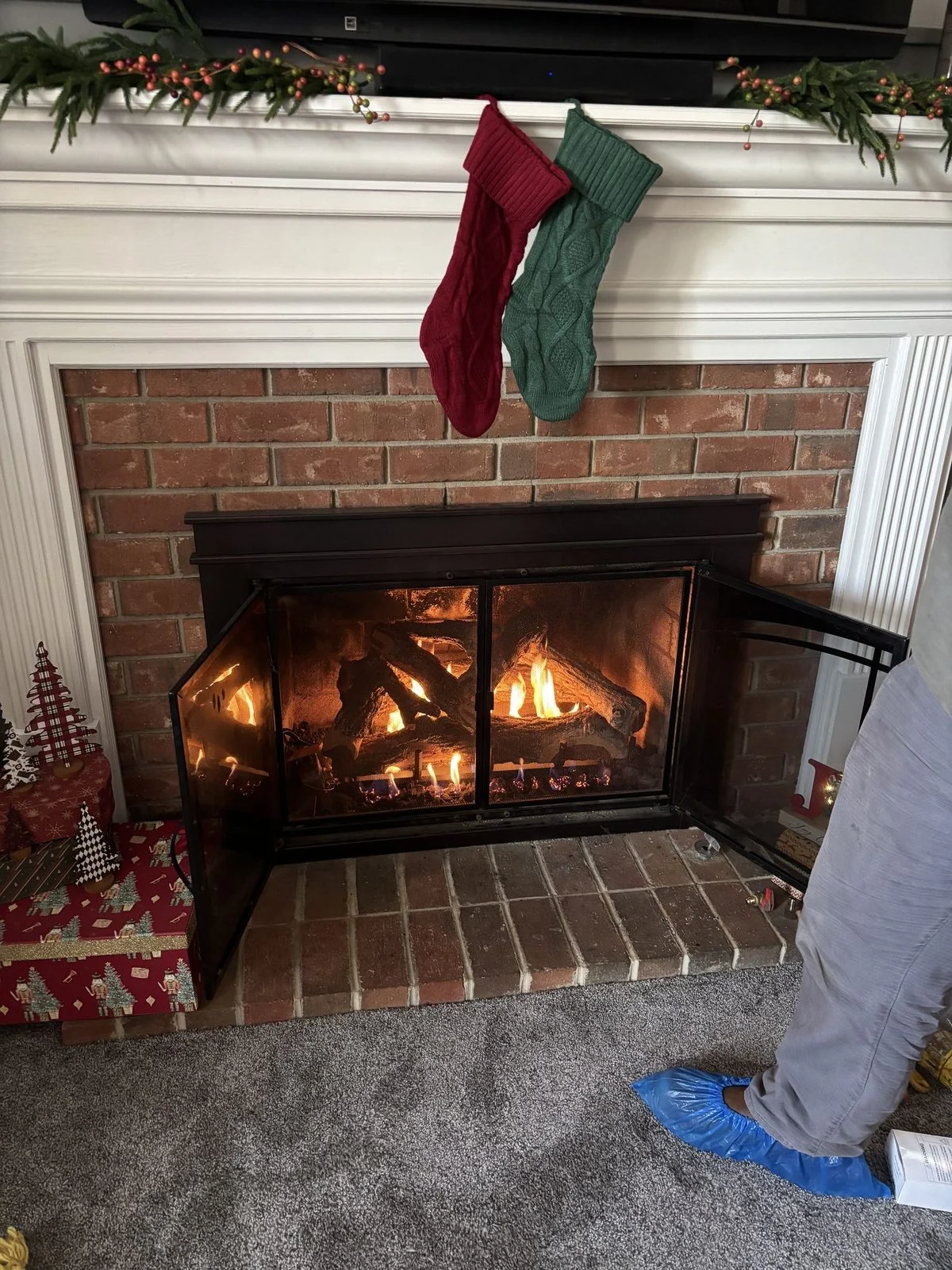
Old fireboxes and log sets that do not fit
Fireplaces in older houses come in odd sizes. Some fireboxes are shallow, some narrow at the back, and some have been partly bricked in over the years. A log set has a minimum firebox size printed on its label, and a set crammed into a box that is too small burns poorly and can scorch the surround.
If you are replacing logs or adding them for the first time, we measure the opening, the depth and the back width first. That decides which sets are even candidates.
Drafty houses, vented logs and the damper
Most older masonry chimneys in town are a good match for vented logs, which send their exhaust up the flue. The code requires the damper on a vented decorative set to be fixed open. On a service call we check that a clamp or stop is in place and that nobody has quietly removed it to cut a draft.
If the room feels cold with the logs off because the damper is fixed open, the answer is a set designed for that chimney or a sealed insert, not a closed damper. We can talk through both.
What a Spartanburg restart call looks like
The common fall complaints are the same across town, and they mostly trace to dust and summer insects in the pilot, a thermocouple or thermopile that has weakened, or a remote receiver with dead batteries.
- Pilot will not catch: check the key valve, clean the pilot orifice and tube
- Pilot drops out on release: test the thermocouple with a meter
- Pilot holds, no burner: test the thermopile, switch wiring and receiver
- Smoky orange flame: reset log positions and clear burner ports
Vent-free logs in older rooms
Some older Spartanburg homes have vent-free sets that a previous owner installed to get more heat out of a drafty room. They work, but they put their moisture and combustion products into the house, and their oxygen depletion sensor will shut them off if the room is too small or closed up.
If a vent-free set keeps shutting itself off, the fix may be cleaning the sensor pilot, opening the room up, or limiting run time. If the room is a bedroom, the set should not be there at all, and we will explain the options.
Adding gas to a wood-burning fireplace
Converting a wood fireplace usually means a new line from the crawlspace, up through the hearth extension or beside it, to a key valve you can reach. That is permitted work, through the City of Spartanburg inside city limits or Spartanburg County outside them, and it gets a pressure test and an inspection before the logs are lit.
Have the chimney swept and inspected first if it has burned wood. A vented gas set relies on a clear, sound flue.
In Spartanburg specifically
More than one fireplace
Older homes sometimes have a capped gas stub at a second or third hearth. If a stub is no longer used, it should be capped properly at the line, not just closed at a key valve.
Piedmont or propane
In town, logs burn Piedmont natural gas. At the county edges they may run on propane. Replacement parts have to match the gas type on the rating label.
Carbon monoxide alarms
An older house with a gas fireplace should have a working CO alarm on each floor and near bedrooms. We check for one on every service call.
Crawlspace gas to the hearth
In most in-town houses the line to the fireplace comes up from the crawlspace. If the key valve is stiff or seeping, the fix is usually reached from below without disturbing the hearth.
How a gas log service call goes
-
Tell us what it is doing
Will not light, goes out, burns dirty, shuts off, smells. The symptom points to the part, so a good description saves time.
-
Shut off, cool down, inspect
We turn off the gas at the valve, confirm the set is cool, and look at the logs, burner, pilot, valve and connector before touching anything.
-
Test the controls
We measure thermocouple or thermopile output, check the switch, remote and wiring, and check gas pressure where needed.
-
Clean and repair
The burner, pan, pilot and ODS are cleaned, and worn parts are replaced with ones that match the manufacturer and the gas type.
-
Leak check and relight
Every connection we touched is leak-checked, the logs go back in their correct positions, and we light the set and watch it run.
-
Walk you through it
We show you how to light it, where the shutoff is, and what a correct flame looks like, so you know when something has changed.
The full guide to gas logs sales, installation & service, and everything else about plumbing and gas in Spartanburg.