Gaffney homes get their water from the Board of Public Works, which draws from the Broad River and Lake Whelchel and treats it at its own plants. Natural gas, for those with a gas heater, comes from Piedmont. Those two facts, plus the age of the house, shape most water heater replacements here.
Older homes in and around the historic district often have the heater in a spot chosen decades ago: a back hall closet, a corner of the kitchen, a basement, or an enclosed porch. Newer homes beyond the old core tend to keep it in a garage or utility room. Each location brings its own venting, drainage and access questions.
We replace gas and electric tanks of all the common sizes, bring the connections up to current code, and file the permit with the City of Gaffney or Cherokee County, depending on where your house sits.
Gaffney is up I-85 from our Spartanburg base. If your tank is leaking now, call any hour and we will walk you through shutting it down while we arrange the replacement.
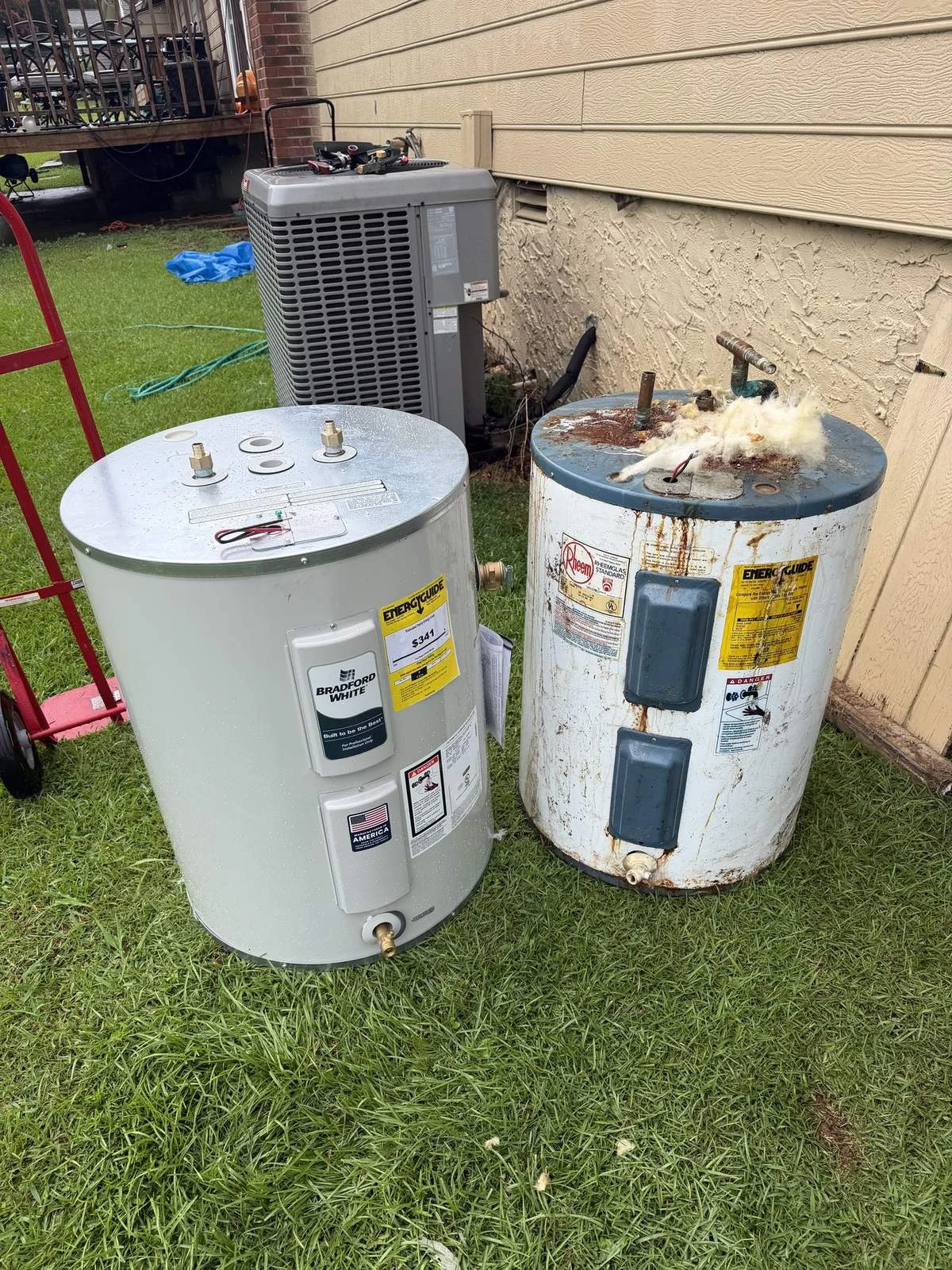
Venting a gas heater in an old house
Many older gas heaters in Gaffney vent into a masonry chimney, sometimes one that once served a furnace too. When the furnace was replaced with a high-efficiency model that vents through plastic pipe, the water heater may have been left alone in a flue far bigger than it needs.
An oversized, cold flue can fail to draft. After every replacement we fire the new heater and check for spillage at the draft hood. If it spills, the options include a properly sized liner or a power-vent heater that exits through a wall.
Wall vents and the historic overlay
A power-vent tank or a tankless unit usually exits through an exterior wall. In Gaffney's Historic Preservation Overlay District, a new vent on a visible wall is the kind of exterior change that can need review by the city.
We plan the vent location with that in mind, favoring rear or side walls out of view, and check with the city before cutting anything on a house in the district.
Old pipe at the heater
Long runs of galvanized supply pipe are common in the older parts of town. Where galvanized connects to the heater, we install dielectric fittings to prevent galvanic corrosion, and we replace short rusted nipples while the water is off.
On the gas side, the new heater gets a shutoff within reach and a sediment trap at the inlet. Every joint we disturb is leak-checked before we leave.
If the house has galvanized pipe throughout, a new heater will not cure low hot-water pressure at distant fixtures. We will tell you if the pipe, not the heater, is the bottleneck.
Sizing for a large house
Big historic houses often have bathrooms far from the heater, added one at a time as the house was updated. A larger tank does not shorten the wait for hot water at a distant bathroom; it only stores more of it. The long pipe run is the delay.
When we size a replacement, we ask about the number of bathrooms, how many showers run back to back and how far the farthest fixture is. Sometimes the right answer is a high-recovery tank of the same size. Sometimes it is a second, smaller heater closer to the far bathrooms.
Code items that come with a replacement
An inspector will look at more than the tank. These are the items most often missing on older Gaffney installs.
- A relief valve discharge line that runs full size, downhill, to a safe termination
- A drain pan piped to a safe place where a leak would damage the house
- An expansion tank if the water system has a check valve or pressure reducing valve
- Proper clearance between the vent connector and wood framing
In Gaffney specifically
Two permit offices
Inside city limits, the City of Gaffney's Community Development department permits water heater work. Outside them, Cherokee County Building Safety on Railroad Avenue does.
Water side questions
For the meter or the line in the street, call the Board of Public Works. For anything from the meter into the house, call a plumber.
Annual flushing still helps
Every tank collects some sediment over time. A yearly flush keeps it quieter and helps the burner or elements transfer heat into the water.
Basement installs
A heater in an older basement often sits near a floor drain. If the drain is clogged or missing, the relief line and pan need another safe place to discharge.
How a water heater replacement runs
-
Measure and match
We confirm the fuel, size, venting, space and clearances so the new heater fits and meets code in that spot.
-
Pull the permit
We file with the city or county office that covers your address.
-
Drain and remove
We shut off the fuel and water, drain the old tank, disconnect it and carry it out.
-
Set and connect
The new tank goes in its pan with new water connectors, a new gas connector or wiring, the discharge line, and an expansion tank where required.
-
Fill, fire and test
We fill the tank with a hot tap open to purge air, light or power it, check the gas connections for leaks, and test the vent for draft.
-
Inspection and haul-away
We schedule the inspection, and the old heater goes with us for disposal or recycling.
The full guide to water heater replacement, and everything else about plumbing and gas in Gaffney.