A water heater replacement in Spartanburg is shaped by two things the house cannot change: where the old tank was put, and what water flows into it. In-town homes put heaters in every imaginable spot, from a basement corner to a back porch that was enclosed in the 1960s. Newer houses at the edge of town tend to keep them in a garage or an attic.
The water itself is on your side. Spartanburg Water draws from Lake Bowen, Lake Blalock and Municipal Reservoir #1, and it is generally soft, so the heavy scale that ruins heaters in hard-water regions is not the usual reason a tank fails here.
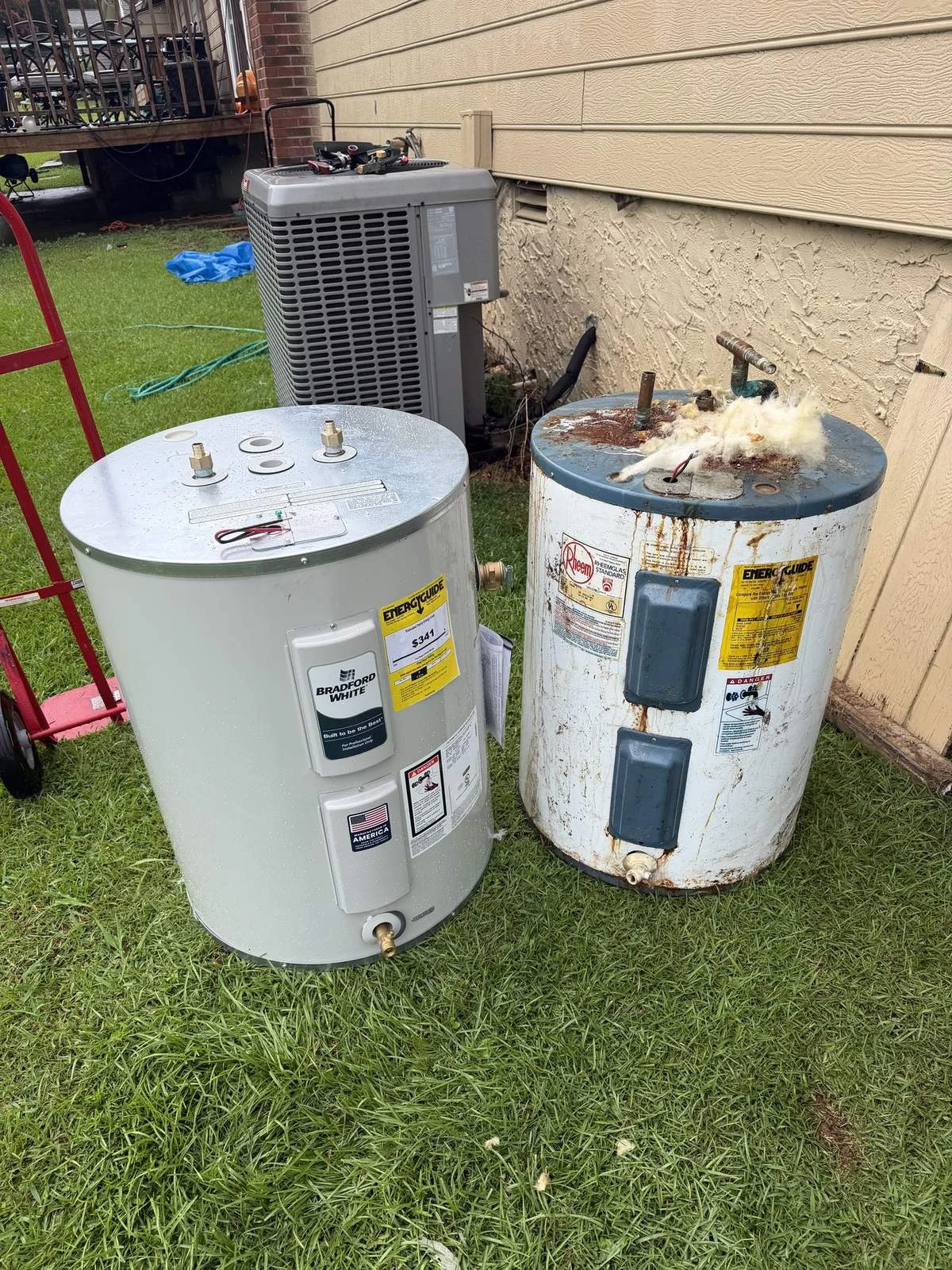
Tanks here mostly die the ordinary way: the steel inside rusts through once the protective anode is spent, and the bottom seam starts to drip. When that happens, we replace the heater, fix the connections around it and file the permit with whichever office covers your address.
Soft water and a tank's lifespan
Soft water means less mineral sediment settling in the bottom of the tank, which is good for efficiency and noise. It does not stop corrosion. The sacrificial anode rod still does the work of protecting the steel, and once it is gone, the tank is on borrowed time.
That is why a new tank is a good moment to set a reminder. Checking the anode every few years and flushing the tank once a year keeps a Spartanburg heater going toward the long end of its range.
Connecting to older pipe
In houses that still have galvanized steel near the heater, the new tank's copper or PEX connections should not screw straight into the old steel. Joining dissimilar metals invites corrosion at the joint. We use dielectric fittings, and where a short stub of rusty galvanized feeds the heater, we replace it while the water is off anyway.
Gas tanks in older homes often connect to steel pipe that has been in place for decades. The new connector gets a fresh shutoff valve and a sediment trap, and we leak-check every joint we disturb.
Venting into an old chimney
Plenty of in-town gas heaters vent into a masonry chimney, sometimes one they used to share with a furnace that has since been replaced by a high-efficiency model. A tank alone in a big old flue can struggle to draft, especially on mild days.
We test the draft after the new tank is fired. If it spills exhaust at the draft hood, the fix might be a liner sized for the heater or a power-vent model that exits through a wall instead.
Sizing for a house that has grown
Plenty of older homes started with one bathroom and now have two or three after additions and remodels. The water heater did not always grow with them. If the household runs out of hot water by the second shower, a replacement is the time to size up or choose a high-recovery model.
We ask how many people shower back to back, whether there is a large soaking tub, and where the bathrooms sit relative to the heater. A long run to a far bathroom wastes water while you wait, and that sometimes points to a different location rather than a bigger tank.
Which office issues the permit
The City of Spartanburg requires a residential permit for this work and treats a water heater as minor work without a plan review. Outside city limits, Spartanburg County Building Codes issues it as plumbing work. We look up the parcel, file with the right one, and book the inspection.
In Spartanburg specifically
Garage installs at the edge of town
Newer homes often have a gas heater in the garage. Its burner has to sit 18 inches up unless the unit is listed as ignition resistant, and it needs protection from a bumper.
Electric in mill houses
Many smaller homes in the old mill villages run electric tanks. Switching to gas is possible where Piedmont has a main, but it means a new line and a vent, so we price the whole picture.
Attic heaters in newer houses
An attic tank needs a pan with a drain line to a safe spot. If the old one had a pan with no drain, that gets fixed during the swap.
Basement stairs and old doorways
Narrow basement stairs and old door openings can be tighter than a modern tank. We measure the path in as well as the spot itself, so the new heater does not get stuck halfway.
How a water heater replacement runs
-
Measure and match
We confirm the fuel, size, venting, space and clearances so the new heater fits and meets code in that spot.
-
Pull the permit
We file with the city or county office that covers your address.
-
Drain and remove
We shut off the fuel and water, drain the old tank, disconnect it and carry it out.
-
Set and connect
The new tank goes in its pan with new water connectors, a new gas connector or wiring, the discharge line, and an expansion tank where required.
-
Fill, fire and test
We fill the tank with a hot tap open to purge air, light or power it, check the gas connections for leaks, and test the vent for draft.
-
Inspection and haul-away
We schedule the inspection, and the old heater goes with us for disposal or recycling.
The full guide to water heater replacement, and everything else about plumbing and gas in Spartanburg.