Most water heaters around Chesnee run on one of three things: propane from a tank in the yard, natural gas from Piedmont where a main reaches, or electricity. The fuel you have decides which heaters are options, how they are vented, and who else is involved in the job.
We replace and install standard tanks, Rinnai and Navien tankless units, and heat pump water heaters. Before you pick one, we look at the space, the venting, the gas or electric supply and how your household actually uses hot water.
The permit follows a route you will not find in most of the county. Inside Chesnee town limits, zoning approval from City Hall comes first, and Cherokee County Building Safety then issues the permit and inspects. Outside town, it is Spartanburg County Building Codes.
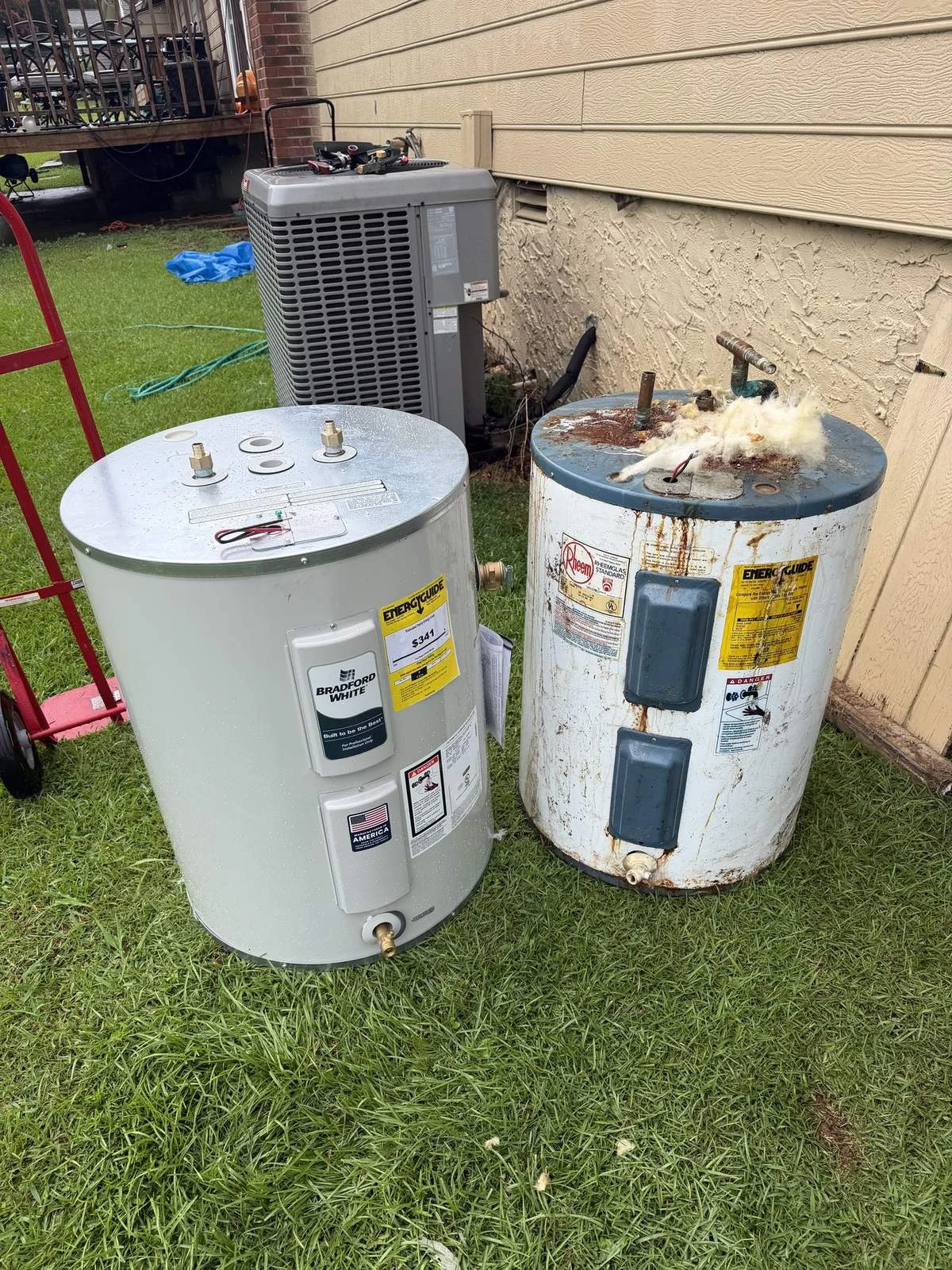
Propane water heaters
Propane runs at a higher pressure through a smaller orifice than natural gas, so a heater has to be built or factory-converted for LP. The rating plate says which, and it is worth checking before the box leaves the store.
Your propane company owns the tank and regulator, and a bigger appliance can outgrow either one. If the new heater adds load, especially a tankless model, we work out the demand and coordinate with your supplier on the regulator and tank size.
The piping from the regulator to the heater is house piping. A new or extended run is pressure-tested before it goes into service, at no less than one and a half times working pressure and never under 3 psig, for at least 10 minutes.
Tankless: Rinnai and Navien
We are certified by both Rinnai and Navien to install and service their tankless water heaters. On propane or natural gas, a tankless unit gives continuous hot water and takes the heater off the floor.
It also asks more of the gas supply than any tank. We size the line from the regulator or meter to the unit for its full input and the length of the run, and on propane we confirm the tank can keep up in cold weather, when propane vaporizes more slowly.
Plan on a yearly flush of the heat exchanger. LCFWD water is soft, which helps, but sediment still collects over time.
Heat pump water heaters and the Duke rebate
In an all-electric home, a heat pump water heater moves heat from the room air into the tank and uses much less electricity than a standard electric heater doing the same job.
As a Duke Energy Trade Ally, Gas Guys can help you claim Duke's rebate on a qualifying unit. That rebate is only for Duke Energy customers, and electric cooperatives such as Broad River Electric Cooperative also serve parts of Spartanburg County, so look at your power bill first.
A heat pump unit needs a roomy, ventilated spot, a condensate drain and a space that stays reasonably warm. An unheated shed or outbuilding is a poor home for one through a Chesnee winter.
Older town houses and farmhouses
Chesnee's core dates to the town's founding around 1910, and its older frame houses, like many farmhouses outside town, often have the heater tucked into a closet, a porch room or the crawlspace. Modern tanks carry more insulation and may not fit the old opening.
In those houses we also check what the old heater was venting into. A deteriorated flue, an unlined masonry chimney or a vent connector with too little rise has to be corrected before a new gas or propane heater is fired.
Details that pass inspection
Cherokee County and Spartanburg County inspectors look at the same core items on a water heater, and we check each one before calling for the inspection.
- A relief valve drain the same size as the valve outlet, ending no more than 6 inches above the floor or at an approved spot outdoors
- An expansion tank sized for the heater when the water supply has a check valve or pressure reducing valve
- A drip leg ahead of the gas or propane control, with a shutoff valve within easy reach
- Correct vent pitch, clearance to combustible framing and enough combustion air for gas-fired units
- A pan with a drain line wherever a leak would reach finished floors or ceilings
In Chesnee specifically
Two-step permit in town
For an address inside Chesnee town limits, zoning approval comes from City Hall on West Cherokee Street before Cherokee County Building Safety issues the permit. We handle both steps and meet the inspector.
Draining on a septic property
Where a home is on septic, we empty the old heater outdoors rather than into a house drain, so a full tank of water and sediment never reaches the septic tank.
Freeze protection for the heater
A heater in a crawlspace, garage or shed can freeze at its inlet and relief lines on the coldest nights. Insulating the exposed piping, and keeping power on to a tankless unit so its built-in freeze protection works, prevents a cracked fitting.
How a water heater replacement runs
-
Measure and match
We confirm the fuel, size, venting, space and clearances so the new heater fits and meets code in that spot.
-
Pull the permit
We file with the city or county office that covers your address.
-
Drain and remove
We shut off the fuel and water, drain the old tank, disconnect it and carry it out.
-
Set and connect
The new tank goes in its pan with new water connectors, a new gas connector or wiring, the discharge line, and an expansion tank where required.
-
Fill, fire and test
We fill the tank with a hot tap open to purge air, light or power it, check the gas connections for leaks, and test the vent for draft.
-
Inspection and haul-away
We schedule the inspection, and the old heater goes with us for disposal or recycling.
The full guide to water heater replacement, and everything else about plumbing and gas in Chesnee.