A water heater in Inman could be sitting in a hall closet of a hundred-year-old mill house, under a crawlspace hatch, in the garage of a 2010s subdivision near I-26, or in a utility room at a house on Lake Bowen. Where it sits decides most of what a replacement involves.
We replace and install tank and tankless water heaters on natural gas, propane and electric. Before you choose a unit, we look at the fuel, the venting, the space and the water lines, and tell you what fits the house you actually have.
Permits are part of the job. Inside city limits that means the City of Inman, which has SAFEbuilt process its permits and inspections. Outside the limits, it is Spartanburg County Building Codes.
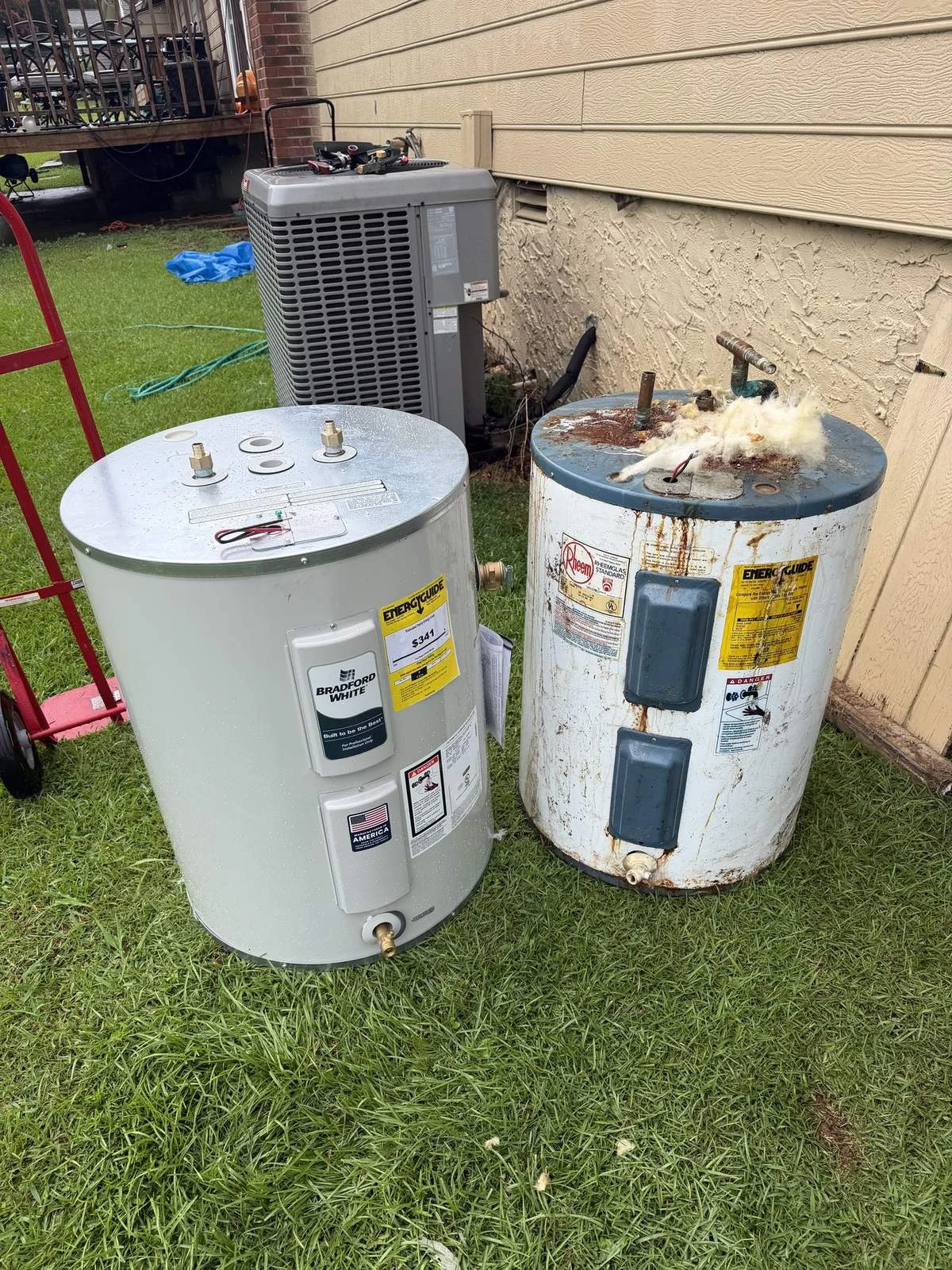
Older Inman houses: tight closets and added-on heaters
Houses built before indoor water heaters were standard got theirs wherever there was room: a back-porch closet, a corner of the kitchen, or down in the crawlspace. Those spots were sized for a 30 or 40 gallon tank decades ago, and a modern tank of the same capacity is often taller or wider because of added insulation.
So we measure the space, the door and the path in before ordering. When the right size will not fit, the options are a lower-profile model, a tankless unit on the wall, or moving the heater to a better spot, and we lay out the trade-offs of each.
A gas heater in an older house also needs a sound vent. Old single-wall flue pipe, a chimney liner that has crumbled, or a vent that rises too little before it turns are common findings, and they get fixed before the new heater is lit.
Natural gas near town, propane farther out
Piedmont Natural Gas serves Inman and the main roads around it. Out past the mains, toward Campobello and the state line, gas heaters run on propane from a tank in the yard.
That matters at the store. A water heater has to be built or converted for the fuel it will burn, and many tank models are sold for one fuel only. Read the rating plate before the box is opened, or send us the model number and we will check it.
If you are thinking of moving from tank to tankless, the gas supply is the first question. A tankless unit can need a much bigger line than the tank it replaces, and on propane the tank regulator and line size have to match it as well.
Inman-Campobello water and your tank
The Inman-Campobello Water District buys its water wholesale from the Broad River Water Authority in Rutherford County, North Carolina, through a supply line built in 2008. It is a different supply from Spartanburg Water's lakes, so what you read about water in the city does not automatically apply here.
Whatever the source, a tank collects some sediment and its anode rod wears away over time. A flush once a year and an anode check every few years help a new tank last, and we show you where the drain valve is before we leave.
Garage and attic heaters in newer subdivisions
Homes built around Inman in recent decades usually put the heater in the garage or the attic. A gas unit in a garage has to have its burner raised off the floor unless it is a flammable-vapor-resistant design, plus a post or barrier if a car could reach it.
An attic heater needs a pan piped to the outside and a clear walkway to carry a full-size tank in and out. If the original heater went up before the drywall, we check that the replacement will pass through the hatch before it is ordered.
What a replacement includes
Taking out the old heater and setting the new one is only part of the work. A proper install in Inman covers each of these.
- A relief valve discharge pipe run full size to a safe spot, ending low
- A drain pan with an outlet where a leak could damage the house
- A sediment trap and a shutoff valve at the gas inlet
- An expansion tank where the water system is closed by a check valve or pressure reducing valve
- Draft and leak checks on the vent and the gas connections once the burner runs
In Inman specifically
City permits through SAFEbuilt
Inside Inman city limits, permits are applied for through SAFEbuilt on the city's online portal, and SAFEbuilt schedules the inspection. We file it and meet the inspector.
Lake Bowen and septic lots
Some homes around the lake and on the county roads drain to a septic tank. When we drain an old heater there, the water goes outdoors, not into the septic system.
Renting in Inman
If you rent, your landlord or property manager authorizes a replacement. Tenants can still call us to stop a leak and shut a heater down safely.
How a water heater replacement runs
-
Measure and match
We confirm the fuel, size, venting, space and clearances so the new heater fits and meets code in that spot.
-
Pull the permit
We file with the city or county office that covers your address.
-
Drain and remove
We shut off the fuel and water, drain the old tank, disconnect it and carry it out.
-
Set and connect
The new tank goes in its pan with new water connectors, a new gas connector or wiring, the discharge line, and an expansion tank where required.
-
Fill, fire and test
We fill the tank with a hot tap open to purge air, light or power it, check the gas connections for leaks, and test the vent for draft.
-
Inspection and haul-away
We schedule the inspection, and the old heater goes with us for disposal or recycling.
The full guide to water heater replacement, and everything else about plumbing and gas in Inman.